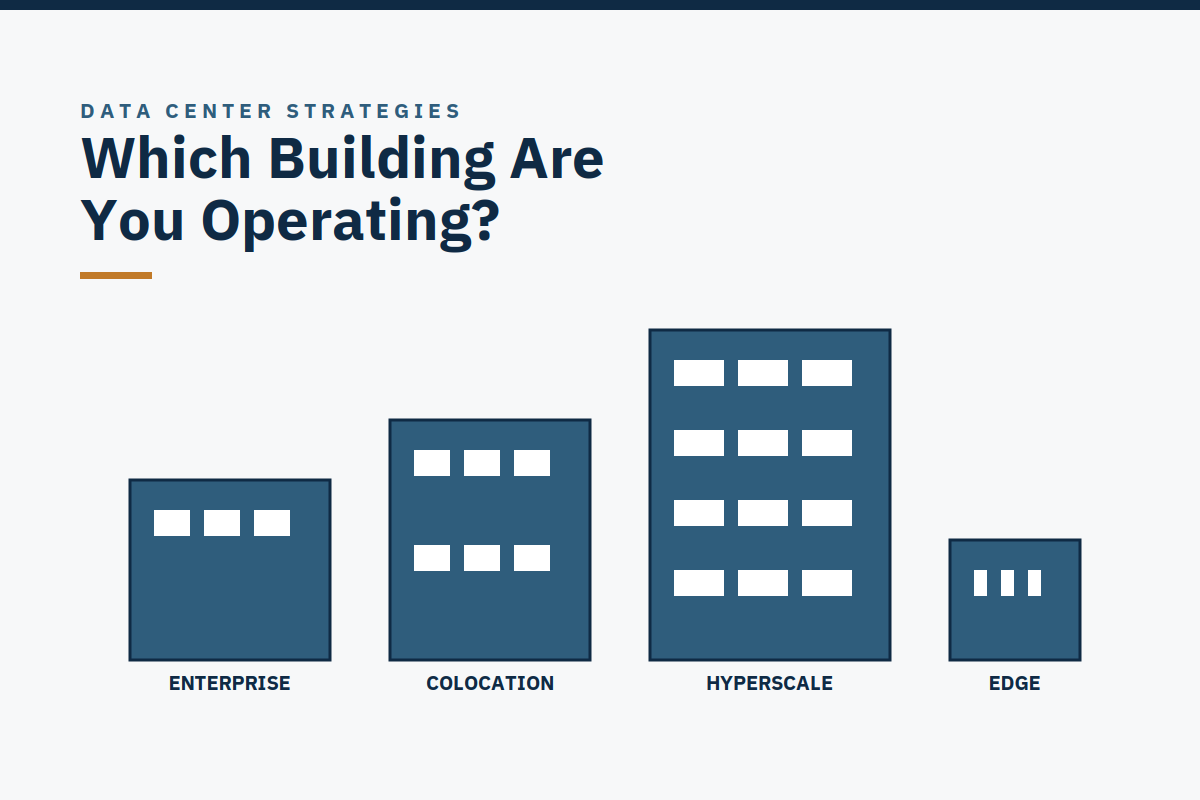
Which building are you actually operating? That is the question this article answers: "who is responsible for what here?" The four established types, enterprise, colocation, hyperscale, and edge, are compared side by side below: who owns the building, who operates it, the typical scale, and how cooling and fiber are usually handled. The scale figures are rough working ranges, not standards; no standard defines them. And the categories overlap: one building can be hyperscale, cloud-hosted, and AI-focused at the same time, and the overlap is where most of the confusion lives.
The four types, side by side
Enterprise. An enterprise data center is built and operated by one company for its own IT. The company owns the building, operates it, and is its own customer. Scale is typically the smallest of the four in the modern market, often a single building, or a room inside a larger building, from a few hundred kilowatts to a few megawatts, though large enterprises have historically run much bigger sites. Cooling is usually air-based, sized for the company's own racks. Fiber is the company's own connection to its offices and to the internet.
The operator's advantage is control: one owner, one set of priorities, no tenant negotiations. The disadvantage is the same: the cost, the staffing, and the risk all sit with one company, and a small team carries all of it.
Colocation. A colocation facility is a building the provider owns and operates, in which many tenants rent space, by the rack, by the cage, or by the hall, and run their own IT inside it. The provider operates the building and the gray space: power, cooling, security, the shell. The tenant operates their own racks inside the white space. Scale is typically mid-range to large, from a few megawatts to tens of megawatts per building, with the largest colocation campuses reaching hyperscale size. Cooling is usually air, increasingly with liquid-cooling options for dense tenants.
Fiber is a selling point: a carrier-neutral facility offers many carriers in the meet-me room, so tenants can choose. The defining feature is the boundary of responsibility. When something fails, the first question is always which side of the boundary it sits on, and the answer is in the contract, not in the building.
Hyperscale. Hyperscale is the scale of a very large cloud or internet business: multi-building campuses, commonly cited at 100 MW and above, highly standardized and automated operations, as explained in Week 6.The operator is usually the owner and the customer at once, a cloud company building for its own platform, though hyperscalers also lease large amounts of colocation capacity. Cooling is increasingly liquid for AI halls and air for everything else, often on the same campus. Fiber is the operator's own backbone, at a scale no other type matches.
The defining feature is repetition: the same hall, the same power path, the same procedure, repeated building after building.
Edge. Edge is the smallest and most distributed type: a micro data center, a containerized unit, or prefabricated modules, placed close to where the data is produced or used, a factory, a hospital, a cell tower, a remote site. Scale is typically well under a megawatt per unit, often tens to hundreds of kilowatts. Cooling is usually air, in a self-contained package. Fiber is the critical link: the backhaul to the larger network is what makes an edge site useful, and when the backhaul fails, the site is on its own.
Edge sites are usually remotely monitored and often lights-out, with no staff on site. Week 49 covers edge and modular in depth.
The boundary of responsibility is the real taxonomy
The table above is useful, but the taxonomy that matters to an operator is the boundary of responsibility. In an enterprise site, the boundary is simple: one owner, one operator, one customer.
In colocation, the boundary runs through the middle of the building, and it is contractual, the provider's obligations end where the tenant's begin, and the exact line is in the service agreement, not on the floor plan. In hyperscale, the boundary is organizational: the team that builds the campus, the team that operates it, and the team that runs the platform on top of it may all work for the same company and still have different responsibilities, different on-call rotations, and different ideas about what "the building" means.
In edge, the boundary is geographic: the site is remote, the operator is elsewhere, and the question is what the site can do on its own when nobody is there.
That is why the operator's question is "who is responsible for what here?" The answer determines which procedures apply, who can authorize work, who gets called at 3 a.m., and who owns the failure when it happens. An operator who moves between employers or facility types, enterprise to colocation, colocation to hyperscale, will find the systems familiar and the responsibility boundary unfamiliar. The systems are the easy part. The boundary is the learning curve.
The categories overlap, and the overlap is the point
The four types are not four boxes. They are four descriptions that can apply to the same building at once. A hyperscale operator's campus can host colocation tenants. A colocation building can host a hyperscale tenant's capacity. An enterprise can run its own hall inside a colocation facility. An edge site can be a small hyperscale node. AI has made the overlap more common, not less: AI workloads live in hyperscale halls, in colocation halls leased by hyperscalers, and in enterprise halls that bought a rack of GPUs.
The overlap also shows up in the market numbers. Third-party facilities, colocation, cloud, hosting, and software-as-a-service, now handle 46% of enterprise IT workloads, against 44% in corporate-owned data centers, the first time third-party has exceeded in-house in Uptime's survey history (VERIFIED, Uptime Institute, Global Data Center Survey 2026, July 2026, more than 1,600 participants in total, including more than 800 data center owners and operators). The shift states where the work has moved: out of the enterprise's own building, and into someone else's, which makes the responsibility boundary, and the operator's ability to read it, more important than it used to be.
Scale figures deserve the same caution. Any "typical megawatts" quoted for a type is a rough working range, not a standard, and it moves every year as density rises. Average facility size was approaching 38 MW in AFCOM's 2026 survey, up from 32 MW the year before (VERIFIED, AFCOM, State of the Data Center 2026, early 2026, survey respondents), a figure that already blurs the old line between "large enterprise" and "small hyperscale." Do not use a size figure to classify a building you are standing in. Use the responsibility boundary instead.
What changes for the operator, type by type
Cooling and fiber are the two systems where the type shows up most directly in daily work. In an enterprise hall, the operator usually owns both end to end. In colocation, the provider owns the cooling plant and the tenant owns the rack-level cooling, and a tenant who brings liquid-cooled racks into an air-cooled hall has just moved the boundary, whether anyone wrote it down or not. In hyperscale, cooling is a campus-level system with hall-level variations, and the operator's job is to know which variation their hall has.
In edge, cooling is a packaged unit, and the operator's job is mostly remote: watch the trend, and know what the site does when the backhaul fails.
Fiber follows the same pattern. In enterprise and hyperscale, the operator's organization usually owns the fiber path end to end. In colocation, the meet-me room is where carriers meet tenants, and carrier-neutral is a commercial policy, the facility welcomes many carriers, not a property of the room itself. In edge, the backhaul is the single most consequential link in the building, and it is usually someone else's network. Week 29 traces the fiber path end to end, and Week 47 covers what AI workloads did to it.
How to use this article
If you are an operator moving between employers or facility types, use this article as a checklist for your first week: find the responsibility boundary in writing, find the authorization matrix, and find out who gets called at 3 a.m. If you are an owner choosing a model, use it the other way round: the model you choose is a choice about where the boundary sits, and the boundary is where the risk sits.
And if you are a general reader, use it to understand why two buildings that look identical from the road can be operated in completely different ways, because the building is not the operation. The operation is the people, the procedures, and the boundary between them.
Takeaway
Enterprise, colocation, hyperscale, and edge describe who owns the building, who operates it, and who the customer is, not four sealed boxes. One building can be hyperscale, cloud-hosted, and AI-focused at the same time. The taxonomy that matters to an operator is the boundary of responsibility: who owns the failure, who can authorize the work, and who gets called at 3 a.m. Size figures are rough working ranges, not standards; use the boundary, not the megawatts, to classify the building you are standing in.
Further reading
- Transition to Operations guide, the guide to taking over a new data center.
- Case Study 6: Building Operator Capability, how operator capability is built in a fast-growing facility.
- Contact, start a conversation about a readiness review; a conversation, not a pitch.
Sources
- Third-party versus in-house workload share: Uptime Institute, Global Data Center Survey 2026, July 2026 (more than 1,600 participants in total, including more than 800 data center owners and operators; the report focuses on owners and operators).
- Average facility size: AFCOM, State of the Data Center 2026, early 2026 (survey respondents).
- Scale ranges for the four types are rough working ranges, not standards.
Published Saturday, October 10, 2026. By Scott Stillings. Scott spent more than twenty years in critical infrastructure operations, as a submarine reactor operator in the U.S. Navy, as a commercial nuclear operator and senior-reactor-operator-certified instructor, and as a critical operations manager for a large hyperscale data center campus. He is the author of Where AI Lives: Inside the Hyperscale Data Centers Powering the AI Boom (Inside Hyperscale).