
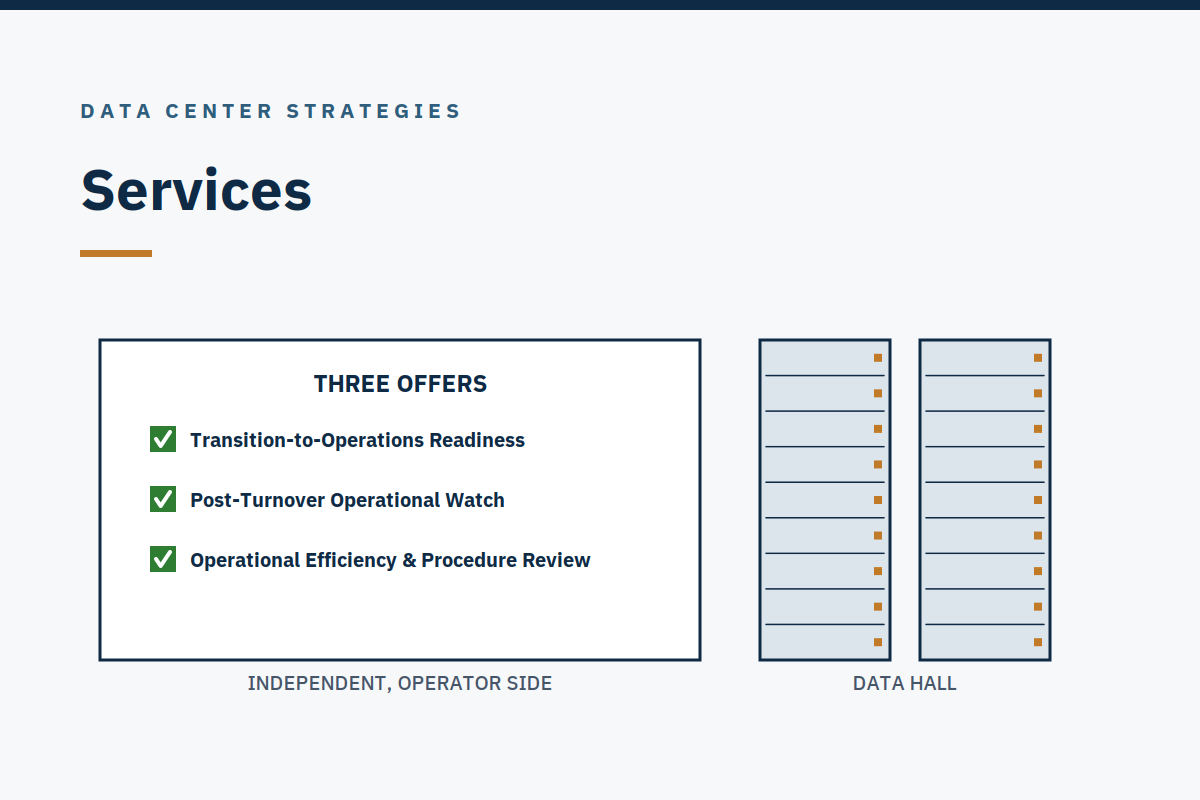
Data Center Strategies offers independent, operator-side help for the transition from construction and commissioning to operations, the readiness check before responsibility transfers, the procedures and drills that make the first year survivable, and a structured watch through the first 90 days and the first year. It is advisory help from an operator who built a data center operation from scratch and took it over at turnover, not engineering design, not commissioning, and not outsourced operations.
Inquiries are welcome now. No fixed price is quoted until a written scope is agreed for your site. Inquire →
Why the transition is the riskiest seam
The transition is where design promises meet operator reality. In Uptime Institute's Global Data Center Survey 2026 (July 2026, over 800 owners and operators), 56% of respondents who had experienced an outage in the prior three years said power was the primary cause of their most damaging incident, up from 45% in 2025 (VERIFIED). In Uptime's Annual Outage Analysis 2026 (May 2026), 92% of respondents said human error was at least a minor contributor to their most recent impactful outage (VERIFIED, Uptime Institute, Annual Outage Analysis 2026, May 2026, Fig. 13, Resiliency Survey 2026), and failure to follow established procedures was the leading driver of human-error outages at 59% (VERIFIED, Uptime Institute, Annual Outage Analysis 2026, May 2026, Fig. 14, Resiliency Survey 2026, n=199). These are survey-based figures with stated uncertainty, not exact counts, and Uptime itself cautions that outage data should be treated skeptically (VERIFIED; Uptime Institute, Annual Outage Analysis 2025, May 2025).
There is no single public operational-readiness standard. Commissioning is covered generically by ASHRAE Guideline 0 / Standard 202; the data-center-specific ASHRAE Guideline 1.6P was only at first public review draft in October 2026, not final (VERIFIED). Uptime's Tier Standard: Operational Sustainability and M&O Stamp of Approval assess operations, but they are assessments, not a step-by-step readiness checklist. Commissioning authorities test systems; facilities-management firms sell taking over operations; neither stands beside the operations manager at the moment responsibility transfers and says "do not sign yet." That is the gap this help is for.
The three offers
Every engagement is described by process and deliverable. The work is advisory: readiness checks, procedures, drills, and first-year support. The price follows a written scope agreed for your site. No fixed price is quoted until a written scope is agreed.
1. Transition-to-Operations Readiness
An independent check, before signing, that people, procedures, asset information, and support arrangements are in place. The governing rule: no responsibility for a completed construction area should be taken on without formal acceptance against pre-defined criteria, with the operations team recruited and trained well before live operations commence (VERIFIED, practitioner doctrine, Future-tech project-acceptance practice, 2020, updated 2024).
Deliverable: a readiness report with a scored gate, sign, sign with conditions, or do not sign, and an owned issue log (severity-classified, owned, independently verified closed). The gate is the Handover Gate: 27 checks scored 0–2, maximum 54; 45–54 with no red lines is Sign, 32–44 with no red lines is Sign with conditions, 0–31 or any red line is Do not sign (ESTIMATE, consultant's method; the Handover Gate is the author's own method, not a standard).
2. Post-Turnover Operational Watch, 90-day / 12-month
A bounded retainer through the first year: baselining, trend review, control-sequence tuning, seasonal-transition planning, infant-mortality triage, and a warranty-expiry punch-list. Commissioning continues up to one year after occupancy, seasonal testing, optimum adjustment, and a warranty review before the construction warranty expires (VERIFIED, documented commissioning practice, Data Center Knowledge / Vertiv).
Deliverable: weekly check-in notes, monthly watch summaries, a triage log, and a close-out report with open items and a warranty-watch list. The 12-month Enhanced tier adds a structured 10-month warranty review and a lessons-learned workshop.
3. Operational Efficiency & Procedure Review
A review of the controlled procedure library, routine procedures (SOPs), detailed step-by-step work that can affect critical load (MOPs), and pre-authorized responses to predicted failure modes (EOPs), against the controlled-library standard: one procedure per document, prerequisites, numbered steps with an expected indication after every state change, a back-out plan, and abort authority. Plus an efficiency spot-check: setpoints, economizer and free-cooling use, and the PUE method. PUE is total facility energy divided by IT energy, and a PUE must be stated with its measurement boundary, period, IT load, and climate, a PUE quoted without those four is not a number, it is a slogan (VERIFIED, definition and method, The Green Grid / ISO/IEC 30134-2:2026).
Deliverable: a procedure review report with findings by document and priority, an efficiency opportunity list (advisory, no design changes), and, at the larger tiers, field validation of the Top-10 EOPs, drill-observation records, and up to five rewritten priority procedures.
Who it is for
- Owners (enterprise, hyperscaler, or investor-owner of a new AI facility) who bear the outage cost and the asset value, and want readiness assurance before signing and before warranty expiry.
- Developers who need to hand over a provably operable asset to the operator or tenant.
- Operators (in-house teams or incoming facilities providers) who will live with the plant and need staffing, qualification, and procedure help.
- Colocation tenants taking over space in a new facility.
By project stage: pre-energization, at integrated systems testing (IST), at signing, in the first year, or at the warranty review. State the stage in your inquiry, the work is different at each.
Scope limits
- Engineering design, re-design, or stamped drawings or calculations: the engineer of record's scope.
- Commissioning (L1–L5 / IST) performed or re-performed: the commissioning authority's scope.
- 24×7 cover, a duty manager, or outsourced operations: facilities management, not advisory help.
- Licensed electrical or mechanical work, or direction of energized work: authorized site or vendor persons under their own permits.
- Site-specific security advice: agreed separately under engagement, not published.
How it starts
- A short conversation, not a pitch. What you are trying to solve, what stage the project is at, and whether this help fits. The initial scoping call (up to 60 minutes, remote) is free. There is no obligation.
- Document and plant review. The owner's project requirements, commissioning records through IST, as-builts as installed (not as designed), current procedures, staffing plan, vendor contracts and service levels, and warranty dates.
- Site walk / readiness review, with the operations team present.
- Gated report, sign, sign with conditions, or do not sign, with an owned issue log.
- Procedure and drill work, then a first-year watch with defined check-ins (30/60/90 days, seasonal, 10-month).
What to bring to the first conversation: project stage, approximate size (MW / IT load range, exact figures need not be shared if confidential), energization/turnover date, cooling type (air, direct-to-chip, or immersion), whether IST is complete, and the single biggest worry.
Scope
Scope: advisory help from an operator. Design, commissioning, and operations remain with the engineer of record, the CxA, and the site team. The final price follows a written scope agreed for your site.
Safety and compliance boundaries
All work is advisory and operator-side. The consultant never directs energized work. All live work is performed by the site's own authorized persons under their own permits, lockout/tagout, and NFPA 70E practice.
Signals a site is at risk in transition
If any of these are true, the site is worth a readiness conversation, whichever firm does the work:
- IST compressed, deferred, or run at partial load without full load banks.
- Issue log with open critical items, or deficiencies "deferred to post-occupancy".
- Turnover package incomplete: no as-builts as installed, no asset register, no maintenance schedule, no O&M manuals.
- Operations team hired late, not present during commissioning, or not yet trained and authorized on the systems.
- No (or undrilled) EOP library; no top-10 EOP list validated in the field.
- Sustained overtime at or above 10%, lean staffing, or an operations-management vacancy. Sustained overtime at or above 10% correlates very strongly with increased incident rates (VERIFIED, practitioner guidance, Uptime Institute, Top 14, February 2021).
- Redundancy on paper only: equipment in bypass, breakers racked out, or a single common dependency IST never fault-injected.
- Liquid-cooling specifics missing: no lab-verified coolant specification at turnover, no air-management or degassing plan, no passivation records, no pressure evidence, no warranty-responsibility matrix.
- No seasonal-transition plan and no 10-month warranty review scheduled.
- Project delayed three months or more with a fixed go-live date, schedule pressure falls on L5/IST and on operations hiring.
How an engagement starts
Tell us about your project and we will scope it together; no engagement starts before a written scope is agreed.
Email us about a project →, include your name, organization, role, project stage, and what you are trying to solve. No payment, no contract, no account creation on this page. We confirm receipt within 24 hours; a full reply follows once we have read your note.