
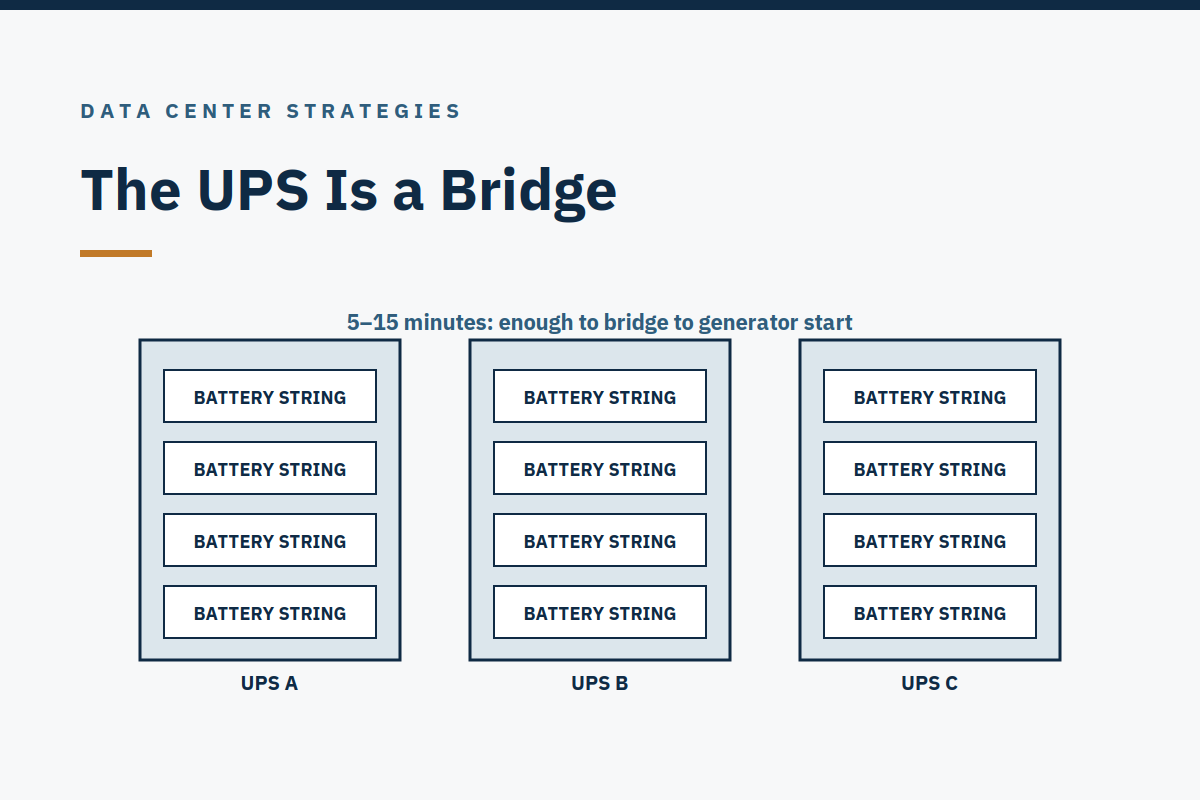
What does a data center UPS actually do? It is a bridge, not a source. It carries the critical load for the seconds between losing utility power and the generators taking it, and it conditions the power while it does so. It is not a long-term source of power, it is not a substitute for a generator, and a UPS sitting on bypass as a steady state is not a UPS at all.
This article explains double-conversion operation in plain language, what 5–15 minutes of battery runtime actually buys, the difference between the two battery types, and the two bypasses, because the operational point is simple, and getting it wrong is expensive.
Double conversion, in plain language
In a double-conversion UPS, the incoming alternating current is converted to direct current. That direct current does two jobs at once: it charges the batteries, and it feeds the inverter. The inverter converts the direct current back to alternating current, and that is what the load sees. The load therefore never sees the raw utility supply. It sees the inverter's output, clean, stable, at the right voltage and frequency, regardless of what the utility is doing.
The double conversion is the point. A UPS that merely passed utility power through to the load would protect against a total outage and nothing else. A double-conversion UPS protects against the far more common problems as well: sags, swells, surges, frequency variation, and harmonic distortion on the incoming supply. The batteries are not a separate system bolted on to the side. They sit on the direct-current bus between the rectifier and the inverter, which is why the transfer to battery needs no switching event: when the utility fails, the rectifier stops, and the batteries simply keep feeding the inverter.
There is no switching event for the load. The load never knows the utility went away, until the batteries run out.
That unbroken transfer is also why the UPS is the most consequential piece of equipment in the power path, and why its failure is the most commonly cited driver of power-related IT service outages. Among power-related IT service outages, UPS failure is the most commonly cited driver at 39% (VERIFIED, Uptime Institute, Annual Outage Analysis 2026, May 2026, base: power-related IT service outages in the Resiliency Survey 2026, n=129). Power remains the leading cause of impactful outages, for the fifth consecutive year in the 2026 analysis (VERIFIED, Uptime Institute, Annual Outage Analysis 2026, May 2026). The UPS is where the power story is won or lost.
What 5–15 minutes actually buys
Battery runtime, autonomy, in a conventional generator-backed design is commonly cited as 5–15 minutes, sufficient to bridge to generator start, and project-specific (VERIFIED, commonly cited range). Five to fifteen minutes is not a long time, and it is worth being precise about what it buys: the time the generator needs to sense the failure, start, stabilize, and accept the load in steps, with margin for one failed start attempt. It does not buy time to diagnose the problem, call a meeting, or wait and see. It buys the generator's start sequence, and nothing else.
What that start sequence looks like, step by step, is Week 11.
The runtime is also not a fixed number for a given UPS. It depends on the load: a UPS carrying half its rated load will run longer on the same batteries than one carrying full load, and a UPS carrying more load than it was sized for will run shorter. It depends on the batteries' age and condition: a string that has lost capacity will not deliver its nameplate runtime, which is why battery monitoring and testing are maintenance tasks, not paperwork.
And it depends on temperature: batteries age faster when they run hot, and a battery room that is warm is a battery room whose runtime is quietly shrinking.
The operational discipline that follows is to know the runtime at the actual load, on the actual batteries, today, not the runtime on the nameplate, and not the runtime on the day the UPS was installed. A runtime test that records a no-load run as a load test proves nothing. Week 15 covers testing discipline in full.
VRLA and lithium-ion
There are two battery types an operator will meet, and they differ in life, footprint, and what they need from the operator.
VRLA, valve-regulated lead-acid, is the established type. Its commonly cited service life is about 3–5 years (VERIFIED, commonly cited range). VRLA batteries are large, heavy, and well understood. They need a controlled temperature, regular inspection, and periodic replacement on a schedule, not on failure, because a VRLA string that fails does so by losing capacity gradually, and the first sign is often a runtime test that comes up short.
Lithium-ion is the newer type in data centers. Its commonly cited service life is about 10 years (calendar life), with a smaller footprint and built-in battery-management monitoring (VERIFIED, commonly cited range). The battery-management system watches each cell's voltage and temperature, which gives the operator far better visibility into the string's condition than VRLA's string-level monitoring. Lithium-ion also brings its own fire-protection considerations: thermal runaway is a self-sustaining reaction that no gaseous agent stops, and off-gas detection is the first line of protection, the subject of Week 32.
The choice between them is a design and procurement decision, and the operator's job is not to relitigate it but to know which type their site has, what its monitoring shows, and when its replacement is due. A battery string past its service life and still in service saves nothing: its runtime no longer exists.
The two bypasses
A UPS has two bypasses, and confusing them is one of the most consequential errors an operator can make.
Static bypass is automatic. On a fault or an overload, the UPS transfers the load to the bypass path, directly to utility power, through a static switch, so that the load stays up while the UPS protects itself. The transfer is fast, and it is the right response to a fault. But while the load is on static bypass, it is on unconditioned utility power, with no stored-energy reserve. If the utility fails while the load is on bypass, the load goes down. Static bypass is a survival mode, not an operating mode.
Maintenance bypass, the wrap-around bypass, is manual, and it lets the whole UPS be isolated for maintenance. The load is transferred to the bypass path, the UPS is taken out of service, and the work is done. While the load is on maintenance bypass, it is again on unconditioned utility power with no stored-energy reserve, and it stays that way for the whole duration of the work, which may be hours. That is the operational fact that matters: a UPS in maintenance bypass is a wire to the utility, and the load it carries has no protection at all.
The discipline that follows is the maintenance trap, covered in full in Week 12: an N+1 plant in maintenance is just N, and a UPS on bypass leaves the load exposed. A UPS left on bypass after the work is finished, because the return-to-service step was skipped, or because the operator was never told the work was done, is one of the most common ways a site silently loses its protection. The return-to-service verification after every maintenance bypass is the step that restores the bridge.
The worked example: a battery replacement
The three procedure types from the SOP / MOP / EOP guide come together on a UPS battery replacement, one of the most common high-risk jobs in a data center. The SOP says how the UPS is normally operated: how to read its status, what normal looks like, what the alarm thresholds mean.
The MOP is written for this specific replacement, on this UPS, on this day, with the transfer to maintenance bypass as a numbered step, the expected indication after the transfer, and the warning that the load is now on unconditioned utility power with no stored-energy reserve. The EOP is what the operator reaches for if the job goes wrong: the UPS fails while on bypass, or the transfer does not complete.
Notice what the example shows: the bypass is the risk, and the procedure is what manages it. The MOP's hold points, its back-out plan, and its abort authority exist because the load is unprotected for the duration of the work, and the operator needs to know, in advance, in writing, what to do if the expected indication does not appear.
A procedure written by someone who never did the task will not have the right expected indications, and the operator will discover that while the load is at risk. Case Study 4, SOP / MOP / EOP Authorship and Drill Validation, shows what happens when procedures are written, drilled, and corrected by the people who use them, including the discovery, across four shifts, that automatic transfer switch times varied from instantaneous to multiple seconds.
Takeaway
A UPS is a bridge, not a source. Double conversion means the load always sees the inverter's output, and the batteries simply keep feeding it when the utility fails.
Five to fifteen minutes of runtime buys the generator's start sequence, and nothing else. VRLA batteries last about 3–5 years, lithium-ion about 10 years (calendar life).
And both need their runtime known at the actual load, on the actual batteries, today.
And a UPS on bypass, static or maintenance, is not a UPS: the load is on unconditioned utility power with no stored-energy reserve, so the return to service after every bypass is the step that restores the protection.
Further reading
- Transition to Operations guide, the guide to taking over a new data center.
- Case Study 4: SOP / MOP / EOP Authorship and Drill Validation, how procedures get good enough to trust at 3 a.m.
- Contact, start a conversation about a procedure review; a conversation, not a pitch.
Sources
- UPS failure as the most commonly cited driver of power-related IT service outages, 39%: Uptime Institute, Annual Outage Analysis 2026, May 2026 (Resiliency Survey 2026, n=129).
- Power as the leading cause of impactful outages for the fifth consecutive year: same source.
- Battery runtime 5–15 minutes: a commonly cited range; the figure varies by project (VERIFIED, commonly cited range).
- Battery service life, VRLA about 3–5 years and lithium-ion about 10 years: a commonly cited range.
Published Saturday, October 31, 2026. By Scott Stillings. Scott spent more than twenty years in critical infrastructure operations, as a submarine reactor operator in the U.S. Navy, as a commercial nuclear operator and senior-reactor-operator-certified instructor, and as a critical operations manager for a large hyperscale data center campus. He is the author of Where AI Lives: Inside the Hyperscale Data Centers Powering the AI Boom (Inside Hyperscale).