
Data Center Strategies, We Build Critical Operations
What the scorecard is
A readiness checklist for the signing moment: the day responsibility for a data center transfers from construction and commissioning to the operations team. Work through each gate before you sign. It is the lead-magnet version of the Handover Gate method, the scored, evidence-based decision at the signing moment: Sign / Sign with conditions / Do not sign.
There is no single public operational-readiness standard, ASHRAE Guideline 1.6P for data-center commissioning was only at first public-review draft in October 2026, so this scorecard is Data Center Strategies' own method, labeled as such.
What it covers
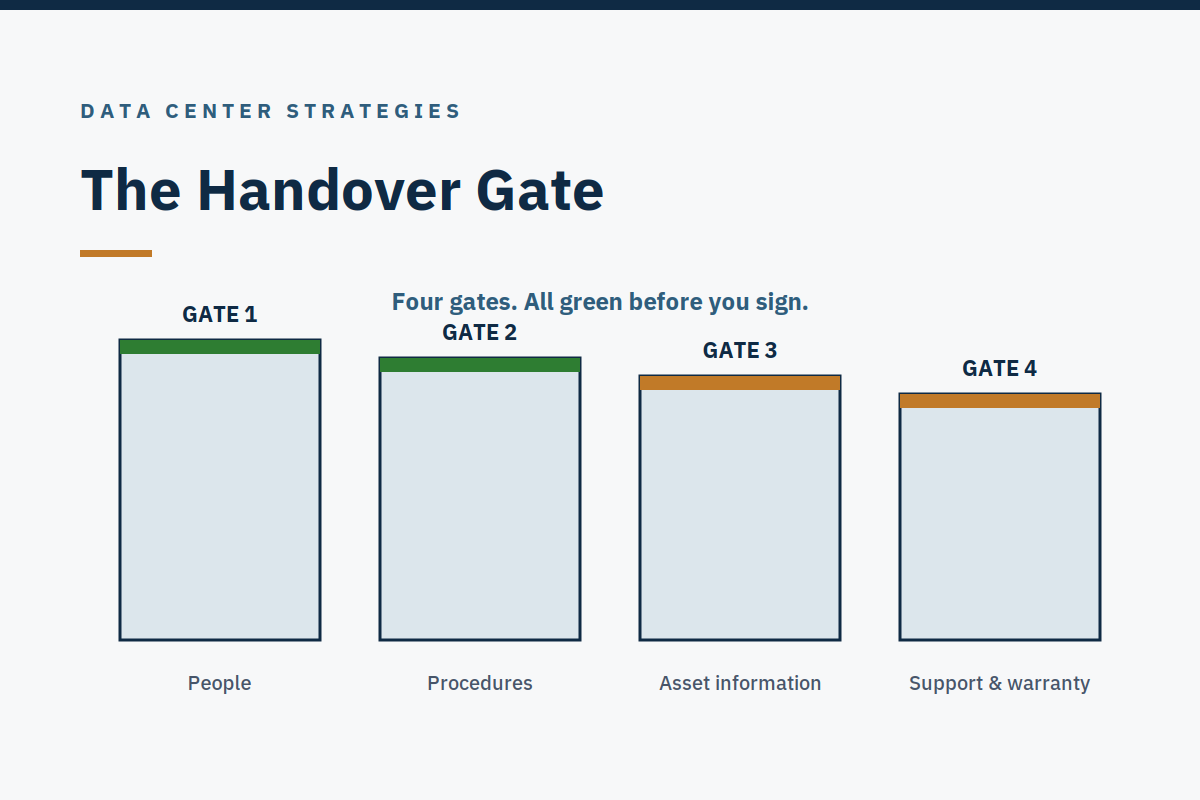
The downloadable scorecard has 32 checks across four gates, 8 checks per gate:
| Gate | What it checks |
|---|---|
| Gate 1: People | Core team hired and in post before turnover; present during commissioning; roles and authorization matrix; training records; shift pattern; overtime and fatigue limits; escalation matrix. |
| Gate 2: Procedures | SOP, MOP, and EOP libraries; document control; expected indication after every state change; Top-10 EOPs walked in the field and drilled; incident-response and lessons-learned process; maintenance procedures and return-to-service verification. |
| Gate 3: Asset Information | Practical Completion and snagging; commissioning records through L5 / IST at design load; as-builts as installed; asset register; O&M manuals; redundancy verified as built; liquid-cooling evidence; IT/firmware, BMS/DCIM, alarm and setpoint schedules. |
| Gate 4: Support & Warranty | Preventive-maintenance schedule; spares; vendor contracts, SLAs, and field-service release controls; warranty boundaries and expiry dates; 10-month warranty review scheduled; seasonal-transition plan; severity-classified issue log; reporting cadence. |
How to score it
Score every check Red / Amber / Green:
- Green, evidenced and verified. The document exists, is current, and has been checked against the plant as installed. The person is named, trained, and authorized.
- Amber, exists but unproven. The document is a draft, the record is unchecked, the drill has not been run, or the item depends on a single person.
- Red, missing, out of date, contradicted by the plant, or never tested.
A gate is Green only when every item in it is Green; Red when it holds any Red. Evidence not provided scores Red.
Do-not-sign rule for this scorecard (guidance, not a certification):
- Any Red in Gate 1 (People) or Gate 2 (Procedures) is a stop. Do not take responsibility for a plant your team cannot yet operate or whose emergency responses are unproven.
- A Red on check 3.1 (open critical items on the issue log), check 3.2 (commissioning records through L5 / IST), or check 3.3 (as-builts as installed, not as designed: single-lines, cooling, fire/life safety, security, cabling) is also a stop.
- Any other Red in Gate 3 (Asset Information) or Gate 4 (Support & Warranty) is a dated, owned condition. Sign only with a dated, owned condition, and schedule the warranty-expiry review before you sign.
- All four gates Green, sign, and keep this scorecard with the handover record.
The full 27-check consultant assessment behind this scorecard applies the same stop on any of its 8 red lines; it is the form Data Center Strategies uses when running the assessment, and it is set out below.
The full Handover Gate behind the scorecard
The scorecard above is the self-assessment checklist. The full consultant assessment it is drawn from, the Handover Gate in the Data Center Strategies consulting method, scores 27 checks, 0–2 each (maximum 54), across the same four pillars (People, Procedures, Asset information, Support / warranty), against 8 red lines, each of which forces "Do not sign" on its own:
| Band | Verdict | Meaning |
|---|---|---|
| 45–54, no red lines | Sign | Take responsibility. Record residual observations in the issue log with owners and dates. |
| 32–44, no red lines | Sign with conditions | Sign only with a written conditions schedule: each condition named, owned, dated, with a stated consequence if it slips (including, where appropriate, a re-gate date). |
| 0–31, or any red line | Do not sign | Do not take responsibility for the area. State the blocking items, the evidence that would clear each, and the re-gate date. |
The 8 red lines: (1) IST (L5) incomplete, compressed to partial load, or run without full load banks; (2) open critical items on the issue log, or deficiencies "deferred to post-occupancy" without formal, owned, dated acceptance; (3) no authorized person available for a critical task the first week will require; (4) sustained overtime at or above 10%, or a rota that depends on it; (5) redundancy on paper only; (6) no leak-response capability on a liquid-cooled site; (7) no controlled EOP for a predicted failure mode the site's own design makes credible; (8) handover package materially incomplete (no as-builts as installed, no asset register, and no PM schedule together). Formal written acceptance by the client decision-maker, with the risk recorded, cures red lines 1 and 2 only. The client decision-maker decides whether to sign; the consultant recommends the gate and evidences it.
Scope and limits
- Not a certification. It does not award Tier or M&O certification, only Uptime Institute does.
- Not a guarantee. It does not guarantee uptime, PUE, or any outcome. "Power In, Heat Out, Nothing Down" is the book's core model, not a consulting promise.
- Not a substitute for commissioning evidence (L1–L5 / IST). It does not re-perform commissioning, witness or sign commissioning test records, or replace the site's own permits, lockout/tagout (LOTO), or NFPA 70E practice.
- Not a design or a fixed price. It provides no engineering design or PE stamp, and no price is quoted before a written scope.
Get the scorecard
Questions about the scorecard or the Handover Gate method: email inquiries@datacenterstrategies.com.
See the method in use
Read the anonymized case studies the Gate is built on: Case Study 1, Transition-to-Operations Readiness applies the Gate retrospectively to a signing moment, and Case Study 2, Post-Turnover Operational Watch covers the first 12 months after it. All six cases are listed on the Case Studies index.
About. Scott Stillings, DataCenterStrategies.com, 20+ years in critical infrastructure operations; author of Where AI Lives (Inside Hyperscale series).