
Case studies drawn from the author's operating experience. Client details are anonymized.
The 60-second first-stabilizing-action target is labeled identically in all six studies: "[Practitioner target, AI Data Center Guide template, not a standard]". The Handover Gate method used in these cases is the consultant's own method, not an industry standard. There is no single public operational-readiness standard: ASHRAE Guideline 1.6P was only at first public review draft in October 2026, VERIFIED, draft, and Uptime Institute's Operational Sustainability and M&O Stamp of Approval are assessments, not a step-by-step readiness checklist.
Figures are labeled VERIFIED, FORECAST, REPORTED, ESTIMATE, or UNVERIFIED. See About for the definitions.
The six studies
| # | Case study | Offer | Question it answers | Key lesson |
|---|---|---|---|---|
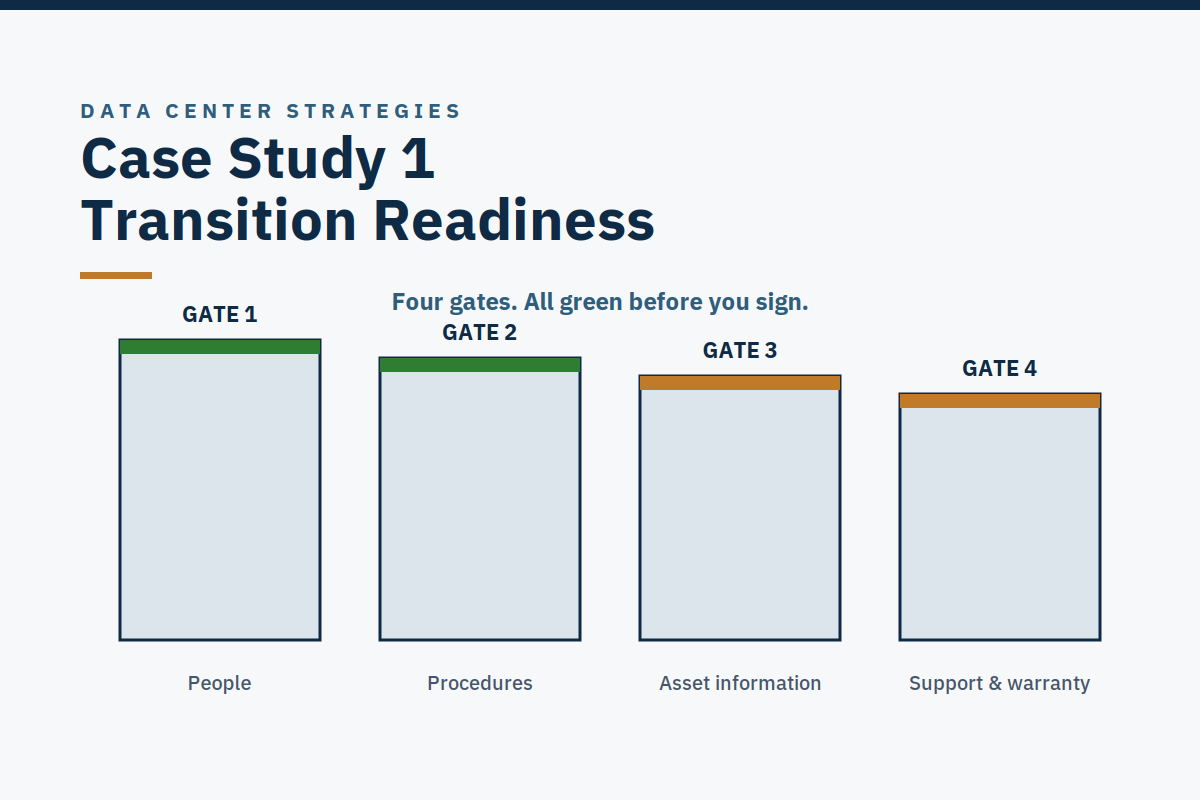
| 1 | Transition-to-Operations Readiness | Transition-to-Operations Readiness | What was missing at handover, and what would the Handover Gate have caught? | A signing party is not a handover. Readiness is People, Procedures, Asset information, and Support/warranty, scored, with red lines, before anyone signs. |
| 2 | Post-Turnover Operational Watch | Post-Turnover Operational Watch (90-day / 12-month) | What drifts in the first 12 months, and how would a watch have caught it earlier? | Infant mortality, seasonal transition, and tuning drift are a pattern, not surprises. A watch looks for drift as well as alarms. |
| 3 | The Silent Compressor Failures | Operational Efficiency & Procedure Review | How do you find a failure that raises no alarm? | Watch the trend, not the alarm. Small chilled-water supply-temperature changes were the only clue to 5–6 silent failures a day. |
| 4 | SOP / MOP / EOP Authorship and Drill Validation | Transition-to-Operations Readiness; Operational Efficiency & Procedure Review | How do procedures get good enough to trust at 3 a.m.? | Slow, consequence-bearing evolutions, predicting indications aloud, and stopping openly when indications differ from the SOP. One shift cannot see what four shifts together can. ATS transfer times varied from instantaneous to multiple seconds. |
| 5 | The Cascading Loss of Cooling | Post-Turnover Operational Watch (90-day / 12-month); Transition-to-Operations Readiness | What buys time when cooling is lost completely? | One pump kept running, recirculation, and a approximately 150,000–250,000-gallon loop's residual heat capacity bought a minute or two, then one chiller, then a second, over several hours. |
| 6 | Building Operator Capability | Transition-to-Operations Readiness; Operational Efficiency & Procedure Review | How do you build operator capability in a fast-growing facility? | Curiosity, psychological safety, seeing the whole picture as a control-room team, not a single operator, and building system knowledge internally. Nuclear method, translated, not copied. |
Start with the scorecard
Before the signing moment, use the free Handover Gate Readiness Scorecard, the lead-magnet form of the Handover Gate method these cases are built on.
Guides and services
- Transition to Operations, taking over a new data center
- The First 12 Months After Turnover, what goes wrong in the first year
- SOP / MOP / EOP, procedures that hold under pressure
- Liquid Cooling Operations, what changes for the operator when cooling is liquid
- Services, transition-to-operations help. Tell us about your project and we will scope it together; no engagement starts before a written scope is agreed.