
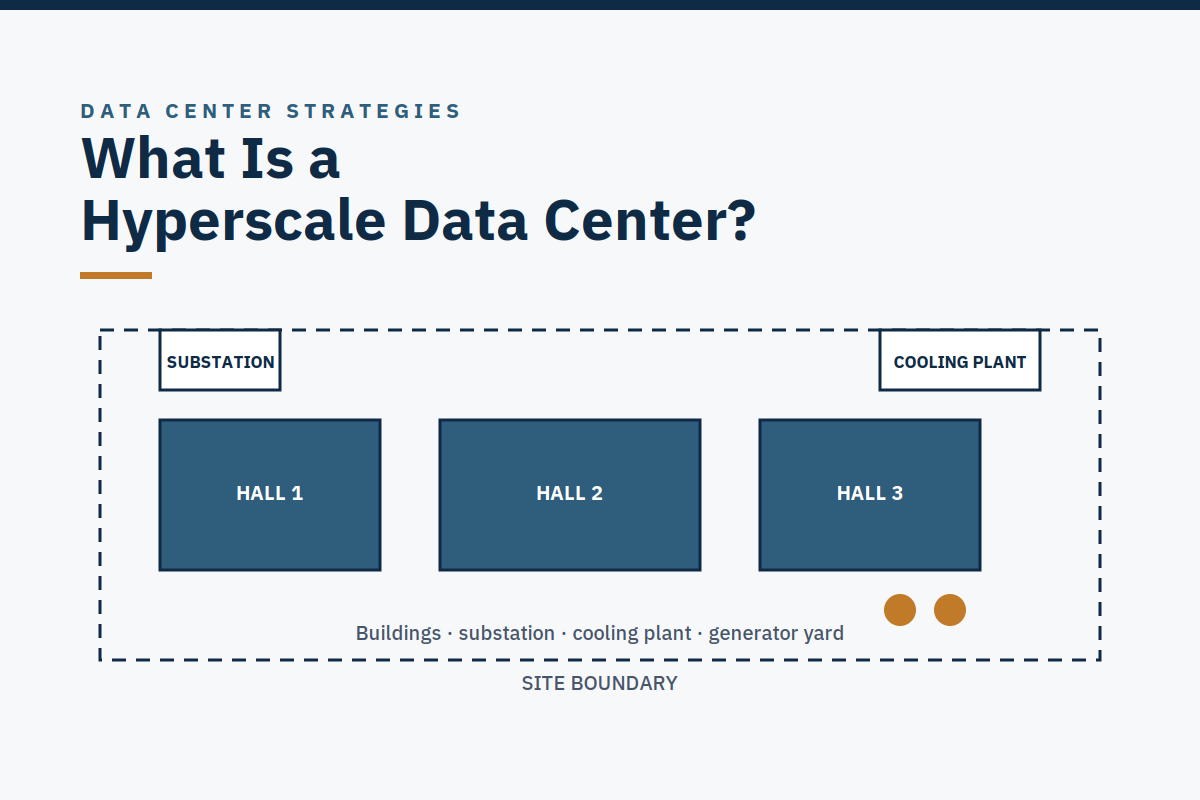
What is a hyperscale data center? The short answer is that it is a data center built at the scale of a very large business, a multi-building campus, run by one operator, that serves a cloud or internet platform used by millions of people. The longer answer is that there is no single universal threshold that makes a building hyperscale.
There is no standard that says "above this many megawatts, you are hyperscale." Scale of business, multi-building campuses, commonly cited at 100 MW and above, highly standardized and automated operations, that cluster of traits is what the word points at, and the absence of a hard line is itself worth understanding before anyone quotes one.
Scale of business, not just size of building
The word "hyperscale" describes the operator's business as much as the building. The hyperscale operators are the small number of very large cloud and internet companies, on the order of twenty firms by the size of their cloud or internet business, whose platforms serve millions of users and whose data center fleets are measured in gigawatts. Synergy Research Group counted 1,360 hyperscale data centers at the end of the fourth quarter of 2025, with hyperscale operators accounting for 48% of worldwide capacity, owning about 60% of that hyperscale capacity themselves and leasing the rest (VERIFIED, Synergy Research Group, 7 April 2026). The same forecaster projects hyperscale operators will account for 67% of all data center capacity by 2031 (FORECAST, Synergy Research Group, 7 April 2026).
That is the first thing to hold on to: hyperscale is a category defined by who operates it and how big their business is, not by a single number on a nameplate. A 100 MW building run by a small operator is not automatically hyperscale, and a hyperscale operator's smaller building does not stop being part of a hyperscale fleet because it is small. The commonly cited 100 MW threshold is a working shorthand, not a standard, useful for conversation, not citable as a rule.
What the scale buys, operationally, is standardization. A hyperscale campus is built from repeated designs: the same hall, the same power path, the same cooling arrangement, repeated building after building. That repetition is what makes the operation automatable.
A fleet of identical halls can be run with the same procedures, the same spares, the same training, and the same monitoring, and a failure in one hall teaches the operator something about every hall like it. The trade-off is that a repeated design also repeats its weaknesses: a design error in one hall is a design error in all of them, which is why the handover and first-year discipline in the Transition to Operations guide and Week 8 matters most at exactly this scale.
What AI changed inside halls that already existed
The second thing to understand is that AI did not invent the hyperscale data center. The buildings, the campuses, and the operating model already existed. What AI changed is the load inside halls that already existed, and the load changed fast enough to break assumptions the buildings were designed around.
The change is density. Average rack density in AFCOM's State of the Data Center 2026 survey was 27 kW, up from 16 kW the year before, and average facility size was approaching 38 MW, up from 32 MW (VERIFIED, AFCOM, State of the Data Center 2026, early 2026, survey respondents). Uptime Institute's Global Data Center Survey 2026 measures density differently, average modal rack density surpassed 11 kW for the first time, with a growing number of operators reporting peak racks of 30 kW or above (VERIFIED, Uptime Institute, Global Data Center Survey 2026, July 2026), so the two figures should not be blended into one number. The direction, though, is the same in both surveys: racks are getting denser, and the densest racks are AI racks.
Dense racks change the physics of the hall. Air cooling has a practical ceiling, and AI racks are past it: air cooling struggles above roughly 30–40 kW per rack, with the same ceiling at about 40–50 kW as an airflow and physics limit, design-dependent (VERIFIED, range across sources, design-dependent). That is why liquid cooling, cold plates on the processors, a coolant loop carrying the heat to a distribution unit and then outdoors, has moved from a niche to the primary heat path in AI halls.
It is also why fiber has become a constraint that matters as much as power: expensive GPUs earn nothing while they wait for data, so the network that keeps them busy is now a first-class operations problem, not a second one.
None of this changed the core model. A hyperscale AI hall still does the same three jobs as any other data center: power in, heat out, nothing down. The power is larger, the heat is more concentrated, and the time available when cooling fails is shorter, in a cold-plate liquid-cooled hall, chip thermal limits can be reached in seconds at full load (VERIFIED, Uptime Institute; one cited case had CDU pump failure to throttling in as little as 23 seconds, a case-specific figure, not a general rule).
But the model holds, which is why the first five weeks of this site spent time on it before getting to AI at all.
Hyperscale is a building type, not a service model
A common confusion is worth clearing up early: hyperscale is a building type, and cloud is a service model. They overlap constantly, most cloud capacity lives in hyperscale buildings, but they are not the same thing, and one building can be hyperscale, cloud-hosted, and AI-focused at the same time.
Cloud is the service: computing, storage, and software delivered over the internet, on demand, without the customer owning the building. Hyperscale is the physical plant that makes that service possible at very large scale: the campus, the buildings, the power and cooling. A company can run a hyperscale campus that hosts no public cloud at all, a large internet platform's own infrastructure, for example. And a cloud service can run partly on capacity leased from a colocation provider, in buildings the cloud company does not own.
The operator's question is "who is responsible for what here?", the question Week 7 compares across all four established facility types.
The distinction matters for the same reason the vocabulary in Week 5 matters: if you confuse the service with the building, you will confuse who owns a failure. When a cloud service goes down, the customer sees a service outage. The operator sees a building problem, a power path, a cooling loop, a procedure, and the building problem is the one they can fix.
What a hyperscale campus looks like from the inside
From the road, a hyperscale campus looks like the building described in Week 1: a plain, warehouse-like appearance, windowless, with very few people coming and going. It is not a warehouse. Inside, the scale shows up in repetition and in automation rather than in spectacle: rows of identical racks, identical power distribution, identical cooling, and a small crew watching a large amount of equipment through monitoring systems that cover the whole campus from one control room.
The crew is small relative to the scale, and that is deliberate. Highly standardized and automated operations are part of what makes the model work: the same procedure, the same alarm response, the same maintenance program, applied across dozens of identical halls. The risk is the mirror image of the benefit. When the operation depends on automation and standardization, the things that break it are the things automation cannot see.
A procedure that was never drilled, a sensor that drifted, a control sequence that was never exercised at real load. Those are the subjects of the operations articles later in the year, and they are the reason this site treats the operator, not the equipment, as the interesting part of the building.
Why this matters to a reader who will never operate one
Most readers of this site will never operate a hyperscale data center. The reason to understand one anyway is concentration. A small number of very large campuses now carry an outsized share of other people's daily life, the services, the businesses, the hospitals and banks and airlines that run on them, and almost nobody driving past can see it.
That concentration is the book's subject, and it is why the book has its own page: Where AI Lives: Inside the Hyperscale Data Centers Powering the AI Boom extends this topic, from the power path to the people on watch at 3 a.m. The site stays on operations and consulting; the book goes deeper on the same subject.
Takeaway
Hyperscale means a data center built at the scale of a very large cloud or internet business, multi-building campuses, commonly cited at 100 MW and above, highly standardized and automated, with no single universal threshold that defines it. AI did not invent the hyperscale data center; it changed the load inside halls that already existed, pushing rack density past what air cooling can handle and making liquid cooling and fiber first-class operations problems. Hyperscale is a building type; cloud is a service model. Confusing the two confuses who owns a failure.
Further reading
- Transition to Operations guide, the guide to taking over a new data center.
- Hyperscale Data Centers guide, the pillar guide to operating at hyperscale scale.
- Where AI Lives, the book extends this topic, from the power path to the people on watch at 3 a.m.
- Contact, start a conversation about a readiness review; a conversation, not a pitch.
Sources
- 1,360 hyperscale data centers at the end of the fourth quarter of 2025, with hyperscale operators accounting for 48% of worldwide capacity, owning about 60% of that hyperscale capacity themselves and leasing the rest; hyperscale operators to account for 67% of all data center capacity by 2031: Synergy Research Group, 7 April 2026. The 2031 share is Synergy's projection.
- Average rack density 27 kW, up from 16 kW the year before, and average facility size approaching 38 MW, up from 32 MW: AFCOM, State of the Data Center 2026, early 2026 (survey respondents).
- Uptime modal rack density: Uptime Institute, Global Data Center Survey 2026, July 2026.
- Air-cooling ceiling of roughly 30–40 kW per rack, with the same ceiling at about 40–50 kW as an airflow and physics limit: a design-dependent range across sources.
- Seconds-scale chip thermal limit, with the 23-second figure flagged as case-specific.
- The 100 MW figure is commonly cited, not a standard.
Published Saturday, October 3, 2026. By Scott Stillings. Scott spent more than twenty years in critical infrastructure operations, as a submarine reactor operator in the U.S. Navy, as a commercial nuclear operator and senior-reactor-operator-certified instructor, and as a critical operations manager for a large hyperscale data center campus. He is the author of Where AI Lives: Inside the Hyperscale Data Centers Powering the AI Boom (Inside Hyperscale).