
Commissioning is the process that is supposed to prove a data center works before operations takes it over. Most explanations of it are written for the people who do the proving, the commissioning agent and the contractors. This one is written for the people who have to live with the result.
There is a caveat to put first, because it will save you an argument. The labels vary. Some projects call L2 installation and static testing and L3 startup; others number the same work differently, and one practitioner guide states plainly that stage definitions may vary by project guidelines. So do not assume your project's numbering matches anyone else's. Use the glossary below as the site's working definitions, and on your own project, ask the commissioning agent to map their numbering to it in writing. The disagreement is about what was actually tested.
L0. The requirements. Before anything is built, the Owner's Project Requirements and the Basis of Design are defined and aligned. This is the agreement about what the building is for: how much power, how much cooling, what redundancy, what the failure modes are. If L0 is vague, every level after it is testing against a moving target. An operator who arrives at L5 and discovers the building was never designed to do what operations assumed is discovering an L0 failure, years too late.
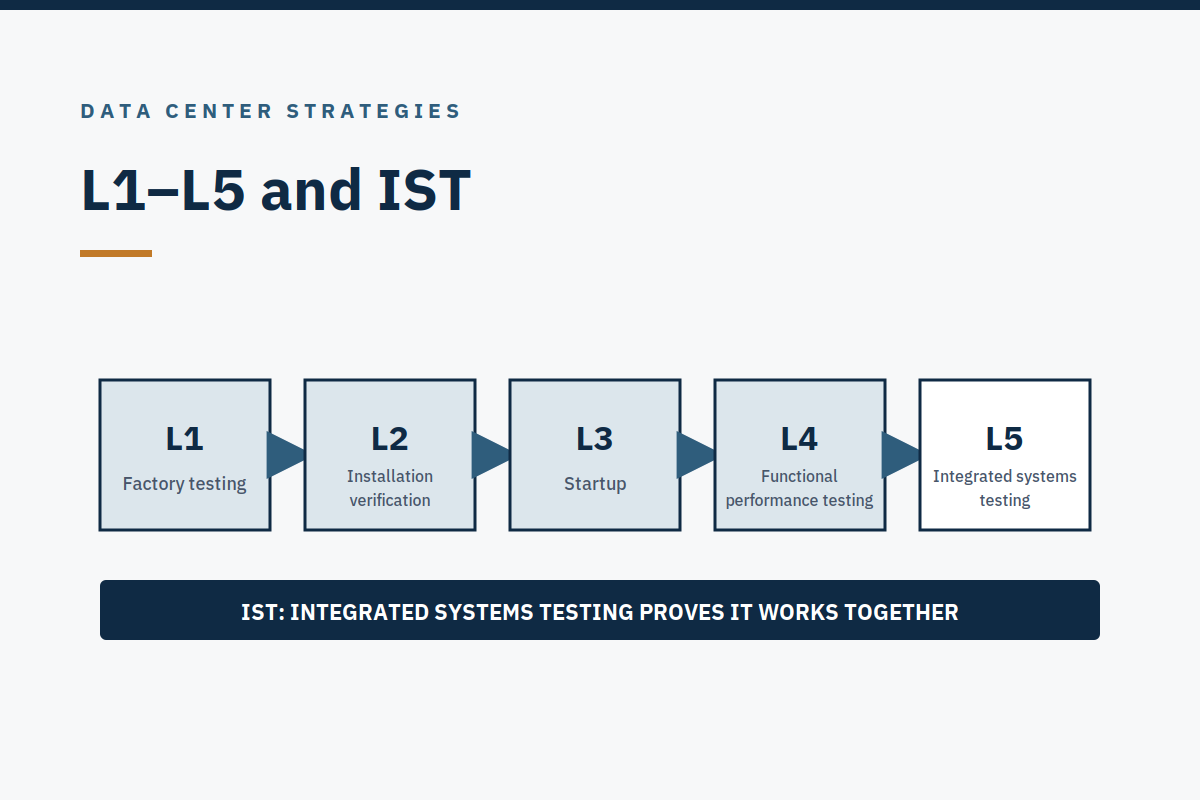
L1, factory acceptance testing. Equipment is tested at the manufacturer, before shipment, to confirm it meets specification. A generator, a UPS, a chiller, a switchboard: each is proved as a unit, on a test stand, before it ever reaches the site. L1 is necessary and it is not sufficient. A unit that passed in the factory can still be installed wrong, wired wrong, or set wrong on site.
L2, site acceptance and static testing. The equipment arrived complete and undamaged, it is installed correctly, and it is safe to energize. This is the level of checklists, torque marks, and point-to-point wiring checks. It is unglamorous and it is where early failures are born: a wiring error, a breaker not fully racked in, a sensor wired to the wrong point.
For facility equipment, the documented early-failure mechanism is more often design, installation, or startup deficiency and control or calibration error than component bathtub mortality (VERIFIED), and the operator's interest in L2 is simple: be present. The core operations staff should be present during commissioning, not hired after it.
L3, pre-functional testing and startup. Installation checklists, energization, alarms, trips, and interlocks, system by system. Each system is started and proved on its own: does this chiller start, does this UPS transfer, does this alarm actually alarm? The controls work at this level is point-to-point testing, every sensor, every valve, every breaker position proved from the field device to the screen that displays it. A point that reads correctly on the screen because someone typed a value into the system, rather than because the sensor measured it, is a failure L3 is supposed to catch.
L4, functional performance testing. Each system performs as designed, on its own, at rated conditions, in every mode: normal, failure, transfer, alarm, and recovery. This is where the operator's training should happen, system training during L4, learning each system while it is being proved. It is also where control sequences are verified against design intent.
The most reliable systems fail when their control sequences do not match what the designer intended, and L4 is the level that catches a chiller staging sequence that fights itself, a valve that hunts, or a generator that starts but never accepts load in the right steps.
L5, integrated systems testing (IST). All systems ride a simulated failure together, at design load. Utility loss, generator start, UPS and transfer, cooling failure, the "pull-the-plug" test, run with load banks, instrumentation, communications, and a safety plan, with issues resolved or formally accepted by the owner before turnover. This is the level that proves the building, not the components.
A UPS that passed L4 and a generator that passed L4 can still fail together at L5, because the handoff between them, the seconds in which the UPS bridges to the generator, the load walks back in steps, and battery recharge adds load on top of the IT load, only exists when the systems run together.
L5 is also the level most at risk from schedule pressure, for a reason that is easy to understand once you have seen it. L5 needs the whole plant, full load banks, and an uninterrupted block of time. A delayed project has none of those to spare.
So L5 is compressed, deferred, or run at partial load, and the failures it would have caught become first-year operational problems instead. That is the mechanism behind the first-year arc this site will describe in Week 8: infant mortality, seasonal transitions, and control tuning problems that integrated systems testing could not fully simulate, because no test can simulate a full year of seasons and real IT load.
What should an operator actually do with all of this? Four things.
First, witness, don't just receive. Attend L4 and L5. Watch the transfer as it would actually happen, not just the engine running. A generator test that records a no-load run as a load test proves nothing about whether the generator will carry the building.
Second, ask for the failure modes, not just the passes. What was fault-injected, at what load, and what happened? A test that never injected a fault never proved redundancy.
Third, own the issue log. Issues from L5 must be classified by severity, assigned an owner, and independently verified closed, not self-certified by the party that created them. An open critical item at signing is a condition, not a footnote.
Fourth, know what commissioning does not do. It does not train your team for you, it does not write your procedures, and it does not operate the building for its first year. Those are operations' jobs, and they start before turnover, not after it. The commissioning agent's incentive is to close the issue log. Operations' incentive is to live with the plant. Those are different incentives, and the signing moment exists to reconcile them.
One last note: ASHRAE Guideline 1.6P, the data-center-specific commissioning guideline, was at first public review draft in October 2026. It is not final, so do not cite it as a published standard. The levels above, the issue-log discipline, and the operator's presence at L4 and L5 are the working method until it is final, and after it is, because only the operator can say whether the building in front of them is ready to be theirs.
Further reading
- Transition to Operations guide, the complete guide to taking over a new data center: the Handover Gate, the 27 checks, and the signing decision.
- The Signing Moment, what "ready for operations" really means, and the three verdicts.
- The First 12 Months, what the year after signing actually brings.
- Case Study 1: Transition-to-Operations Readiness, what was missing at handover, and what the Handover Gate would have caught.
- Contact, start a conversation about a readiness review; a conversation, not a pitch.
Sources
This article draws on Where AI Lives, Chapters 8 and 10.
- ASHRAE Guideline 1.6P was at first public review draft in October 2026, not final.
- Early facility failures documented as design, installation, or startup deficiency and control or calibration error, with no percentage attached: Pinheiro, Weber, and Barroso, Failure Trends in a Large Disk Drive Population, USENIX FAST '07.
- The Donato 2013 figure is dated, single-source, and not verified against a second source.
Published Saturday, September 12, 2026. By Scott Stillings. Scott's background is in critical infrastructure operations. U.S. Navy submarine reactor operator, commercial nuclear operator and senior-reactor-operator-certified instructor, and hyperscale data center critical operations manager. He is the author of Where AI Lives: Inside the Hyperscale Data Centers Powering the AI Boom (Inside Hyperscale).