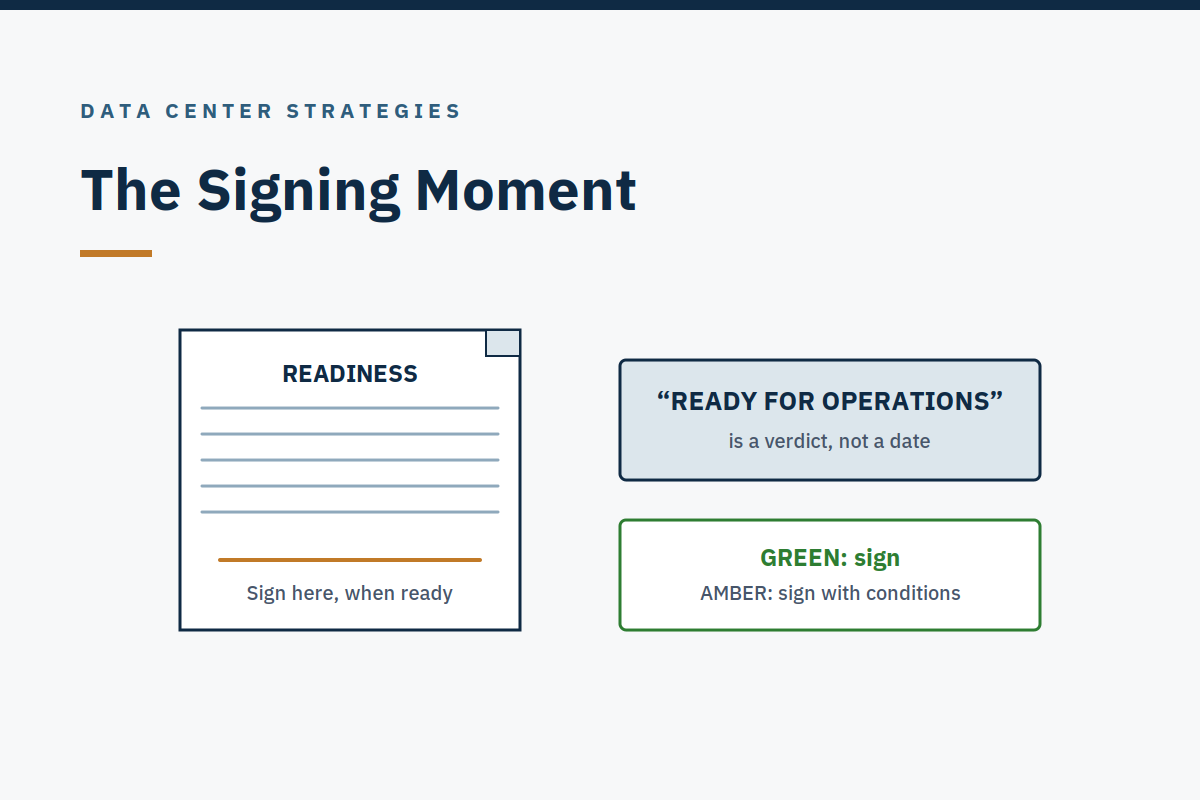
There is a moment in the life of every new data center that has no equivalent in most other industries. One day, the building belongs to the people who designed and built it. The next day, it belongs to the people who have to operate it, and the transfer happens all at once, in a signature.
Call it the signing moment. Before it, a problem is the contractor's problem. After it, a problem at 3 a.m. is the operations team's problem, and the team that takes it over has never owned or operated a data center before, at least, not this one. The equipment is new. The control sequences are unproven under real load. The procedures were written by people who have not yet run them. That is the condition the signature creates, and it is why the transition to operations is the riskiest seam in a data center's life.
It is worth saying plainly what the research behind this site found: there is no single public standard for operational readiness. Commissioning is covered generically by ASHRAE Guideline 0 and Standard 202, and the data-center-specific ASHRAE Guideline 1.6P was only at first public review draft in October 2026, not final. Uptime Institute's Tier Standard: Operational Sustainability and its Management & Operations Stamp of Approval assess operations, but they are assessments and certifications, not a step-by-step readiness checklist an operator can download and follow.
That absence is the reason an operator's judgment matters at the signing moment, and the reason this site exists.
So what does "ready for operations" actually mean? It means four things are true at the same time, and each one can be checked.
First, the turnover package is complete. That means the practical completion document and an agreed snagging list; a complete and accurate asset list; the full commissioning program completed through integrated systems testing, with records updated; all hard and soft operations and maintenance documentation in full before operations takes responsibility; and a documented planned maintenance schedule with a full set of maintenance records.
It also means as-built drawings that show the building as installed, not as designed, because the two are never identical, plus electrical single-lines, mechanical and cooling drawings, fire and life-safety drawings, security and cabling drawings, equipment schedules, and the IT and firmware matrix. If any of that is missing, operations is being asked to run a building it cannot fully describe.
Second, deficiencies are closed or formally accepted. Integrated systems testing, the full-plant failure test described in next week's article, produces an issue log. The rule that commissioning practitioners state, and that operations should hold, is that no level is skipped and deficiencies are resolved before advancing, not deferred to post-occupancy. A deficiency deferred to post-occupancy becomes an operational problem, usually at the worst possible time.
That does not mean every item must be closed before signing; it means every open item must be formally accepted by the owner, with a named owner and a date, and the operator must know which ones they are. An issue log with open critical items, or deficiencies quietly "deferred," is a signal to stop. The readiness report an independent operator writes at this gate has only three possible verdicts: sign, sign with conditions, or do not sign. "Sign with conditions" is a real verdict, not a polite way of saying yes.
The conditions are the list, and they have owners and dates.
Third, the people are ready. The core operations staff should have been recruited and trained well before live production begins, and ideally present during commissioning. That is the doctrine in the published handover guidance, and it is routinely violated: the team is hired late, arrives after the testing is done, and is asked to learn the building while it is already in service. Training here does not mean a classroom course.
It means system training during functional testing, full-facility rehearsals during integrated systems testing, and emergency-procedure drills in the field after energization, walking every emergency operating procedure in the actual hall, with the actual alarms, until the first stabilizing action is fast and certain. A certificate does not prove a technician can run this plant's procedures under load. Only a drill does.
Fourth, the procedures exist and have been validated. That means a controlled library, standard operating procedures for routine work, methods of procedure for step-by-step work that can affect critical load, and emergency operating procedures for predicted failure modes, with document control, review dates, and a named approver. It means the top emergency procedures have been field-validated after energization and reviewed at least annually.
And it means the team has rehearsed them, because Uptime Institute's outage analysis keeps returning to the same finding: a large share of human-error outages stem from staff failing to follow procedures. In the 2026 analysis, 92% of respondents said human error was at least a minor contributor to their most recent impactful outage (VERIFIED, Uptime Institute, Annual Outage Analysis 2026, May 2026, Fig. 13, Resiliency Survey 2026). Failure to follow established procedures was the leading driver of human-error outages at 59% (VERIFIED, same source, Fig. 14, Resiliency Survey 2026, n=199). Human error is a contributing factor here, not a root cause, and the 92% must never be read as 92% of outages caused by human error. Procedures are not paperwork. They are the product, the subject of Chapter 10 of the book, and of Week 4 of this series.
There is a pattern to the sites that get this wrong, and it is worth naming because it is checkable from outside. Integrated systems testing is compressed, deferred, or run at partial load without full load banks. The turnover package is incomplete. The operations team was hired late or was not present during commissioning. There is no drilled emergency-procedure library. Sustained overtime is already above ten percent, which Uptime's guidance correlates very strongly with increased incident rates (VERIFIED, Uptime Institute, Top 14, February 2021, practitioner guidance).
Redundancy exists on paper only, equipment sitting in bypass, a breaker racked out and never racked back, a single common dependency that testing never fault-injected. And for a liquid-cooled site, the coolant specifics are missing: no lab-verified coolant specification at turnover, no air-management plan, no passivation records, no pressure evidence, no warranty-responsibility matrix between the cooling vendor, the IT vendor, and the installer.
The question to carry into the signing meeting is therefore a simple one, and it is the question this site will return to all year: can this team, with these procedures, on this plant, hold the three jobs, power in, heat out, nothing down, through the first failure? If the answer is yes, sign. If the answer is yes with conditions, write the conditions down, name their owners, and sign. If the answer is no, do not sign yet. The building will wait. The first failure will not.
Further reading
- Transition to Operations guide, the complete guide to taking over a new data center: the Handover Gate, the 27 checks, and the signing decision.
- L1–L5 and IST, Explained for the Operator Who Has to Live With the Result, what each commissioning level proves, and what it does not.
- The First 12 Months, what the year after signing actually brings.
- Case Study 1: Transition-to-Operations Readiness, what was missing at handover, and what the Handover Gate would have caught.
- Contact, start a conversation about a readiness review; a conversation, not a pitch.
Sources
- ASHRAE Guideline 1.6P was at first public review draft in October 2026, not final.
- Human error as at least a minor contributor for 92% of respondents' most recent impactful outage (Fig. 13), and failure to follow established procedures as the leading driver of human-error outages at 59% (Fig. 14, n=199): Uptime Institute, Annual Outage Analysis 2026, May 2026, Resiliency Survey 2026.
- Sustained overtime at or above 10% correlates very strongly with increased incident rates: Uptime Institute, Top 14, February 2021 (practitioner guidance).
Published Saturday, September 5, 2026. By Scott Stillings. Scott built a data center operation from scratch at a newly constructed, new-design liquid-cooled AI facility: hired the team in advance of turnover, prepared the procedures, set shift-operations expectations, and took over at turnover. He is the author of Where AI Lives: Inside the Hyperscale Data Centers Powering the AI Boom (Inside Hyperscale). No employer names, site names, or proprietary details are published on this site.