
Summary: the short version. Ask an operator what keeps a data center up and you will get one of two answers: the equipment, or the procedures. The procedures are the right answer, because the equipment only does what the procedures tell people to do with it, and procedures are where data centers most often fail. In Uptime Institute's Annual Outage Analysis 2026 (May 2026), failure to follow established procedures was the leading driver of human-error outages at 59% (n=199) (VERIFIED, Uptime Institute, Annual Outage Analysis 2026, May 2026, Fig. 14).
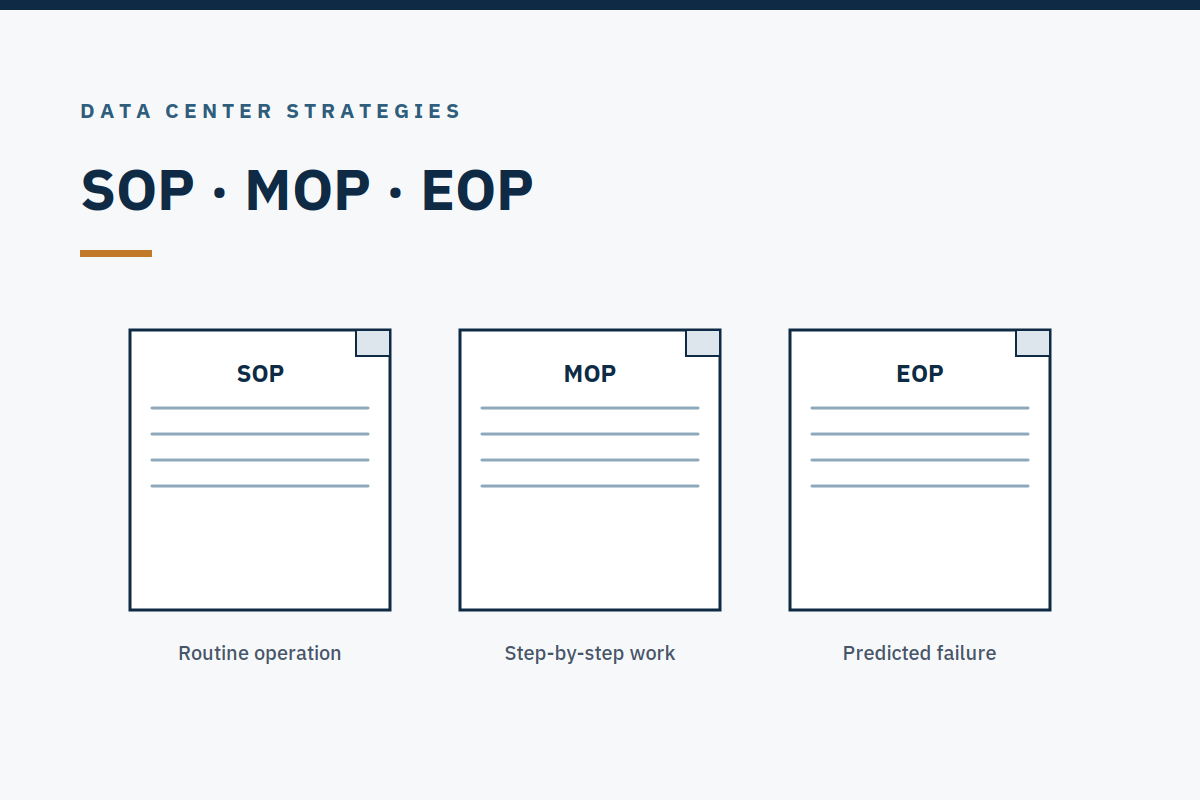
There are three kinds of procedure, and confusing them is the first failure: a SOP is how routine work is done, a MOP is a detailed step-by-step plan for one specific job that can affect critical load, and an EOP is the pre-authorized response to a predicted failure. This guide defines each one, shows how they work together in a UPS battery replacement, gives the ten rules for writing a procedure an operator can follow at 3 a.m., and explains how drills, not signatures, prove a procedure works.
Why procedures are the product
Uptime Institute's outage analysis keeps returning to the same finding. In its 2026 analysis, failure to follow established procedures was the leading driver of human-error outages at 59%; incorrect staff processes or procedures 36%; installation issues 25%; insufficient staff 25%; in-service issues 23% (respondents chose up to three) (VERIFIED, Uptime Institute, Annual Outage Analysis 2026, May 2026, Fig. 14, Resiliency Survey 2026, n=199).
In the 2026 analysis, 92% of respondents said human error was at least a minor contributor to their most recent impactful outage (VERIFIED, Uptime Institute, Annual Outage Analysis 2026, May 2026, Fig. 13, Resiliency Survey 2026). Human error is a contributing factor here, not a root cause, and the 92% must never be read as 92% of outages caused by human error.
Uptime's own caution applies to all of these figures: "Data relating to outages should be treated skeptically. All methodologies… are subject to uncertainty, partly because of a lack of transparency and reliable reporting mechanisms" (VERIFIED, method note, Uptime Institute, Annual Outage Analysis 2025, May 2025).
The direction is unmistakable even with that uncertainty: the dominant preventable cause of outages is procedures, missing, flawed, or ignored. That is why the procedure library is one of the four pillars of the Handover Gate, why the first year tests it hardest (see the First 12 Months guide, failure modes F10 and F4), and why this guide treats procedures as the product, not the paperwork. The equipment is the plant. The procedures are what make the plant operable.
What is a SOP, a MOP, and an EOP?
The three types have different purposes, different authors, and different moments of use. Learn the distinction once and the rest of the library makes sense.
SOP: standard operating procedure: how routine work is done
A SOP describes the normal operation of a system: starting and stopping a chiller, taking rounds, doing a shift handover, checking battery voltages, checking coolant levels on a liquid-cooled loop. A SOP is written for the steady state. It assumes the plant is healthy and the task is one the team does regularly. Its virtue is consistency: the same task, done the same way, by any qualified operator, on any shift. Its failure mode is staleness, a SOP written when the plant was commissioned, never updated after a control change, describing a screen that no longer exists.
A related term you will meet on some sites: an SCP, or Site Configuration Procedure, is the normal configuration of the plant, the state the SOPs assume. And MMS procedures are the maintenance program itself, distinct from the CMMS software that schedules it. If it is not in the CMMS, it did not happen, for audit purposes.
MOP: method of procedure: one job, one day, step by step
A MOP is a detailed, step-by-step plan for a specific piece of work that can affect critical load. It is written for one job, on one system, on one day: replacing a UPS battery string, racking out a breaker, transferring a load to maintenance bypass, isolating a CDU loop for a repair. It has numbered steps, with the expected indication after every state change. What the operator should see after doing each step, so a wrong step is caught immediately rather than three steps later.
It has prerequisites, notifications (who must be told before the work starts), a back-out plan for reversing the work if something goes wrong, and abort authority: who can stop the work, and under what condition. It has hold points, timestamps, initial blocks, and signature fields. A good MOP is very detailed, and a procedure library for a real facility runs to hundreds of documents.
The MOP's failure mode is authorship by someone who never did the task: steps in the wrong order, wrong expected indications, and no back-out plan that works, discovered while the load is at risk. That is the single most common way a planned intervention becomes an outage, and it is failure mode F10 in the first-year catalogue: a maintenance-induced failure, where a planned intervention causes the outage it was meant to prevent.
EOP: emergency operating procedure: the decision made in advance
An EOP is the pre-authorized response to a predicted failure mode. Loss of utility power. Loss of cooling. A UPS on bypass with a second fault. A fire alarm in a hall. A coolant leak. The EOP is written before the failure happens, reviewed by the owner, the operator, the engineer, and the constructor, field-validated after energization, and reviewed at least annually. It tells the operator what the first stabilizing action is, who does it, and what "stable" looks like, before the alarm, not during it.
Its failure mode is the shelf: an EOP that was written, filed, and never drilled. An EOP means little if it is not rehearsed. The best readiness guidance says the test is to regularly simulate every EOP scenario, including disconnecting pumps, chillers, and air handlers to trigger authentic alarms. The target in one practitioner template is that the first stabilizing action is inside sixty seconds of opening the document (Practitioner target. AI Data Center Guide template, not a standard).
That is a demanding standard, and it is the right one: in a cold-plate liquid-cooled hall, chip thermal limits can be reached in seconds when circulation is lost, not minutes (VERIFIED, citing Uptime Institute).
An EOP must be usable by the least-experienced authorized person at 3 a.m. under alarm. If only your most senior operator can follow it, it is not an EOP. It is a note to your most senior operator.
How the three work together: a UPS battery replacement
Take a UPS battery replacement: one of the most common high-risk jobs in a data center. A UPS is a bridge, not a long-term source: its runtime in a conventional generator-backed design is commonly cited as 5–15 minutes, sufficient to bridge to generator start, project-specific (VERIFIED, commonly cited range). Battery service lives commonly cited: VRLA about 3–5 years; lithium-ion about 10 years (calendar life; about 2,000–3,000 cycles), with smaller footprint and built-in battery-management monitoring (VERIFIED, commonly cited range; lithium-ion calendar life per the data-center-systems skill, electrical reference).
The SOP says how the UPS is normally operated: how to read its status, what normal looks like, what the alarm thresholds mean. The operator knows the SOP before the job starts.
The MOP is written for this specific replacement, on this UPS, on this day. It lists the prerequisites (the load, the bypass path, the notifications), then the steps in order: notify, verify the bypass path is available, transfer the UPS to maintenance bypass, with the expected indication after the transfer, and the warning that the load is now on unconditioned utility power with no stored-energy reserve, isolate the battery string, replace it, verify the new string, return the UPS to service, and verify the load is back on the UPS with the batteries charging. At each step, the expected indication.
At the end, the back-out plan and the abort authority. If the transfer to bypass does not produce the expected indication, the MOP says stop, and the operator stops, because the MOP said so in advance, not because they improvised in the moment.
The EOP is what the operator reaches for if the job goes wrong anyway: the UPS fails while on bypass, or the transfer does not complete. The EOP does not repeat the MOP. It says what the failure looks like, what the first action is, and who takes it. The operator does not have to decide, under alarm, whether to restore utility power or to shed load. That decision was made months ago, in a calm room, by people who had time to think.
Notice what the example shows: a procedure is a decision made in advance, by the people who will live with it, in the order they will use it. The library fails in predictable ways. Written by someone who never did the task, copied from another site without checking this site's equipment, never field-validated, never drilled, or never reviewed after a control change.
How to write a MOP operators will actually follow: ten rules
These are the writing rules from the consulting playbook. They apply to all three procedure types, and most strictly to MOPs.
- One procedure, one job, one document. If a document covers two jobs, it will be followed for neither.
- Start with the decision, not the history. Header block: purpose in one sentence; when to use it; when NOT to use it; prerequisites; notifications required before starting; abort authority, who may stop it, and the words to use; expected end state.
- Numbered steps, one action per step. "Open valve V-101 on the CDU-A return header." Not "open the valve and check the pressure and notify the duty manager", that is three steps pretending to be one.
- Expected indication after every state change, and what to do if it does not appear. Stop, hold, or back out. Never "continue and see".
- Hold points marked HOLD before irreversible actions, verified by a second authorized person.
- Back-out plan before the first irreversible step, and the point of no return stated in the text.
- Times, not vibes. State the wait and the indication that ends it.
- Write for the reader who is tired, alone, and under alarm. Short sentences, no jargon without a definition on first use, equipment identifiers exactly as labeled in the field. Fix the label before publishing the procedure.
- Field-validate before issue. The author walks every step in the field with an operator who has not written it, on the real plant, in the real state the procedure assumes. Steps that cannot be performed as written are rewritten, not annotated. Field validation happens after energization for EOPs.
- Version control is safety control. One controlled copy, version number, owner, review date, withdrawal rule for superseded versions. A superseded MOP in a drawer is a live hazard.
Procedure quality checks: pass or fail
A procedure fails review if any check fails. There is no partial pass.
- Trigger and non-trigger stated. The operator can tell in under 30 seconds whether this is the right document.
- Prerequisites complete and checkable. Not "ensure the system is ready". A list that can be ticked.
- Every state-change step has an expected indication and an "if not seen, do this" branch.
- Hold points marked before irreversible actions, verifier named.
- Back-out plan present, point of no return stated.
- Abort authority named, the words to stop in the text.
- No step requires the operator to remember a value not printed in the step.
- References are to controlled documents by version, not to "the manual" or a person's memory.
- Field-walked by someone other than the author, walk record attached.
- Drill-validated (EOPs) or rehearsed (MOPs).
- Review date set, annual for EOPs at minimum; immediately after any plant change, incident, or drill finding.
- Language checked: one action per step, imperative verbs, equipment IDs matching field labels.
Review the library on that basis and most libraries fail in the same three places: expected indications missing, back-out plans missing, and field validation never done. Those three are also the three that matter most when the load is at risk, which is not a coincidence. They are the three that take the most work to write, so they are the three that get skipped when the library is written under schedule pressure, which is when it is usually written.
Drills: how a procedure earns trust
A procedure earns trust in a drill, not in a signature. There are two kinds of rehearsal, and they are not interchangeable. A tabletop is a walk-through discussion. A drill is a rehearsal of an EOP in which the fault is actually injected under controlled conditions. A tabletop is not a drill. Record which one happened.
The drill cadence in the consulting playbook is the consultant's own method, not a standard, label it as such: ESTIMATE, consultant's method. Top-10 EOPs drilled at least annually each; loss-of-power and loss-of-cooling drilled at least twice a year in the first year; one injected-fault drill per quarter in the first year.
Authorization currency follows the same logic: EOP authorization lapses after 12 months without a drill of that EOP; MOP authorization lapses after 12 months without performing or rehearsing it. Validate the cadence and currency periods against the site's risk profile and any customer or audit requirement before publishing them as a commitment.
What a good drill looks like, in practice: slow, consequence-bearing evolutions; operators predicting indications aloud before acting; and stopping openly when indications differ from the SOP. That last part is the hardest and the most important. Stopping is not failure. Stopping is the procedure working, the operator trusted the expected indication more than the momentum of the job. A drill culture in which nobody ever stops is a drill culture that has never tested anything.
Worked example: what drills found that paperwork never would
Case Study 4: SOP / MOP / EOP Authorship and Drill Validation is a case study about exactly this: how procedures get good enough to trust at 3 a.m. The recorded facts in the author's account are that automatic transfer switch (ATS) transfer times varied from instantaneous to multiple seconds across shifts, one shift cannot see what four shifts together can, and that slow, consequence-bearing evolutions with predicting indications aloud and stopping openly when indications differed from the SOP were what made the procedures trustworthy.
The ATS values and SOP-error counts per drill cycle in the case study's graphs are ILLUSTRATIVE, drawn to show the pattern; no transfer times were measured or recorded in publishable form. Read it for the method, not the numbers: the drill is where a procedure written by someone who never did the task is caught, and the drill is where the operator learns whether the expected indication is real.
Two more cases show what happens when the procedure side is weak. Case Study 3: The Silent Compressor Failures, eight compressors across four chiller plants failing silently, five to six times a day, with no alarm, is a procedure problem as much as a monitoring problem: no alarm, no event log, and no procedure that said "watch the chilled-water supply temperature trend" until someone wrote one.
And Case Study 5: The Cascading Loss of Cooling is the EOP case: a loss-of-cooling EOP with a first stabilizing action inside 60 seconds is the difference between a controlled response and improvisation while chip thermal limits are reached in seconds (Practitioner target. AI Data Center Guide template, not a standard; seconds-scale claim VERIFIED).
Alarm linkage, change control, and the library as a system
A procedure library is a system, not a shelf of documents. Three links hold it together.
Alarm linkage. Every alarm that can fire has a named procedure or a named "no action, monitor" disposition. An alarm with no procedure behind it is a noise the operator has been trained to ignore, and the next alarm, the one that matters, will be ignored with it. Acceptable steady state is below 1 alarm per 10 minutes per operator; a flood is more than 10 alarms in 10 minutes; one alarm = one required action (VERIFIED, ISA-18.2 and EEMUA 191 / IEC 62682, via published summaries).
Change control. No setpoint, sequence, or procedure change without review, approval, and a return-to-service check. This is Handover Gate check 13, and it is the link between the procedure library and the plant: a control change that is not reflected in the procedures is a procedure that now describes a plant that no longer exists. The first-year catalogue's tuning failure mode (F3) is usually a change-control failure wearing a tuning costume, someone changed a setpoint, nobody recorded it, and the next operator followed a procedure written for the old setpoint.
Document control. One procedure per document, version, owner, review date, and a single controlled copy. Superseded versions are withdrawn, not filed next to the current one. The review date is annual for EOPs at minimum, and immediate after any plant change, incident, or drill finding. A library that is not reviewed after an incident is a library that has decided the incident taught it nothing.
When to ask for help: Operational Efficiency & Procedure Review
The third of Data Center Strategies' three offers is Operational Efficiency & Procedure Review: review of the SOP / MOP / EOP library and operating efficiency, procedure quality, drill validation, and setpoint and cooling-efficiency opportunities. Advisory only, no design changes. The consultant recommends operational changes (setpoints, sequences, schedules, procedures, monitoring) and identifies where a design change would be needed, for the engineer of record to assess.
He does not redesign plant, never changes a setpoint, sequence, or staging logic, never instructs a change, and never promises a PUE or WUE figure. Changes are made only by the site's authorized persons under change control, with owner and engineer-of-record agreement.
No fixed price is quoted here, because a fixed price for undefined scope is never quoted. Pricing follows scoping, and the scope of a procedure review depends on the size of the library and the state it is in. That is a guardrail, not a sales tactic: a library of hundreds of documents cannot be priced from a phone call. To start a conversation, see the contact page. Tell us about your project and we will scope it together; no engagement starts before a written scope is agreed.
What this offer does not do, stated plainly: it does not award or guarantee Tier or M&O certification (only Uptime Institute does that); it does not provide engineering design or a PE stamp; it does not re-perform commissioning; it does not provide 24×7 cover or operate the site; it does not perform or direct licensed or energized work; and it promises no zero-outage guarantee, guaranteed uptime figure, or guaranteed PUE or saving figure.
Questions operators ask about procedures
How many procedures should we have? As many as the plant requires, and no more. A library for a real facility runs to hundreds of documents, one per job, one per failure mode, and that is normal. The wrong question is the count. The right question is coverage: does the library cover every routine operation the first 90 days will require, every planned intervention on critical plant, and the Top-10/15/20 predicted failure modes? Those are Handover Gate checks 8, 9, and 10, and they are the coverage test.
Who should write the MOPs? Someone who has done the task, or who writes it with someone who has, and then field-walks it with an operator who has not written it. A MOP written by someone who never did the task is the single most common authorship failure, and it is caught by the field walk, not by a desk review. If the author cannot walk the steps in the field, the MOP is not ready.
How often should EOPs be drilled? The playbook's method (ESTIMATE, consultant's method): Top-10 EOPs at least annually each; loss-of-power and loss-of-cooling at least twice a year in the first year; one injected-fault drill per quarter in the first year. Validate against the site's risk profile and any customer or audit requirement. The principle behind the numbers is simpler: an EOP that has not been drilled is a hypothesis, and the first real alarm is a bad time to test a hypothesis.
What is the difference between a drill and a tabletop? A tabletop is a discussion. A drill injects the fault under controlled conditions, with authentic alarms. Both have value; only the drill proves the operator can do the first stabilizing action fast enough. Record which one happened, and do not let a tabletop be reported as a drill.
Our procedures were copied from another site. Is that a problem? Only if they were not checked against this site's equipment. A copied procedure with the wrong equipment identifiers, the wrong expected indications, or the wrong bypass path is worse than no procedure, because it carries the authority of a document and the accuracy of a guess. Check every copied procedure in the field, on this plant, before it is issued.
Further reading
Further reading: SOP vs MOP vs EOP: The Three Procedures That Keep a Data Center Up, How to Write a MOP Operators Will Actually Follow, and Change Management: How to Approve, Schedule, and Roll Back a Change.
Sources
Sources for the figures cited in this guide.
- Uptime Institute, Annual Outage Analysis 2026 (Keynote Report 201), May 2026, Fig. 14, failure to follow established procedures the leading driver of human-error outages at 59% (n=199, Resiliency Survey 2026); incorrect staff processes/procedures 36%; installation issues 25%; insufficient staff 25%; in-service issues 23% (choose up to three). VERIFIED.
- Human error as at least a minor contributor for 92% of respondents’ most recent impactful outage (Fig. 13), and failure to follow established procedures as the leading driver of human-error outages at 59% (Fig. 14, n=199): Uptime Institute, Annual Outage Analysis 2026, May 2026, Resiliency Survey 2026.
- Uptime Institute, Annual Outage Analysis 2025, May 2025, "Data relating to outages should be treated skeptically. All methodologies… are subject to uncertainty, partly because of a lack of transparency and reliable reporting mechanisms." VERIFIED, method note.
- ISA-18.2 and EEMUA 191 / IEC 62682, via published summaries, acceptable steady state below 1 alarm per 10 minutes per operator; a flood is more than 10 alarms in 10 minutes; one alarm = one required action. VERIFIED. Paywalled standards, cite via published summaries, do not invent clause numbers.
- Uptime Institute, in a cold-plate liquid-cooled hall, chip thermal limits can be reached in seconds at full load; one cited case had CDU pump failure to throttling in as little as 23 seconds. VERIFIED for the seconds-scale claim; the 23-second figure is case-specific and must not be generalized.
- UPS runtime commonly cited as 5–15 minutes; VRLA battery life about 3–5 years; lithium-ion about 10 years (calendar life). VERIFIED, commonly cited ranges; lithium-ion calendar life per the data-center-systems skill, electrical reference.
- Data Center Strategies consulting method, Operational Efficiency & Procedure Review §2.3, procedure method, procedure quality checks, drill cadence and authorization currency (consultant's own method, ESTIMATE, consultant's method).
- Case Study 4: SOP / MOP / EOP Authorship and Drill Validation; Case Study 3: The Silent Compressor Failures; Case Study 5: The Cascading Loss of Cooling (case studies, November 7, 2026). ATS values, SOP-error counts, day-by-day splits, and temperature values are ILLUSTRATIVE unless a caption states a recorded rate.
Takeaway. A procedure is a decision made in advance, by the people who will live with it, in the order they will use it. Write one procedure per job, with numbered steps, an expected indication after every state change, hold points before irreversible actions, a back-out plan, and abort authority, then field-validate it with someone who did not write it and drill it until the first stabilizing action is fast. A procedure that has never been drilled is a hypothesis, and the first real alarm is a bad time to test a hypothesis.
Next: read The First 12 Months After Turnover for the year that will test your library hardest, and Liquid Cooling Operations for the procedures a liquid-cooled hall adds, leak response, coolant checks, and a loss of cooling that is measured in seconds.