
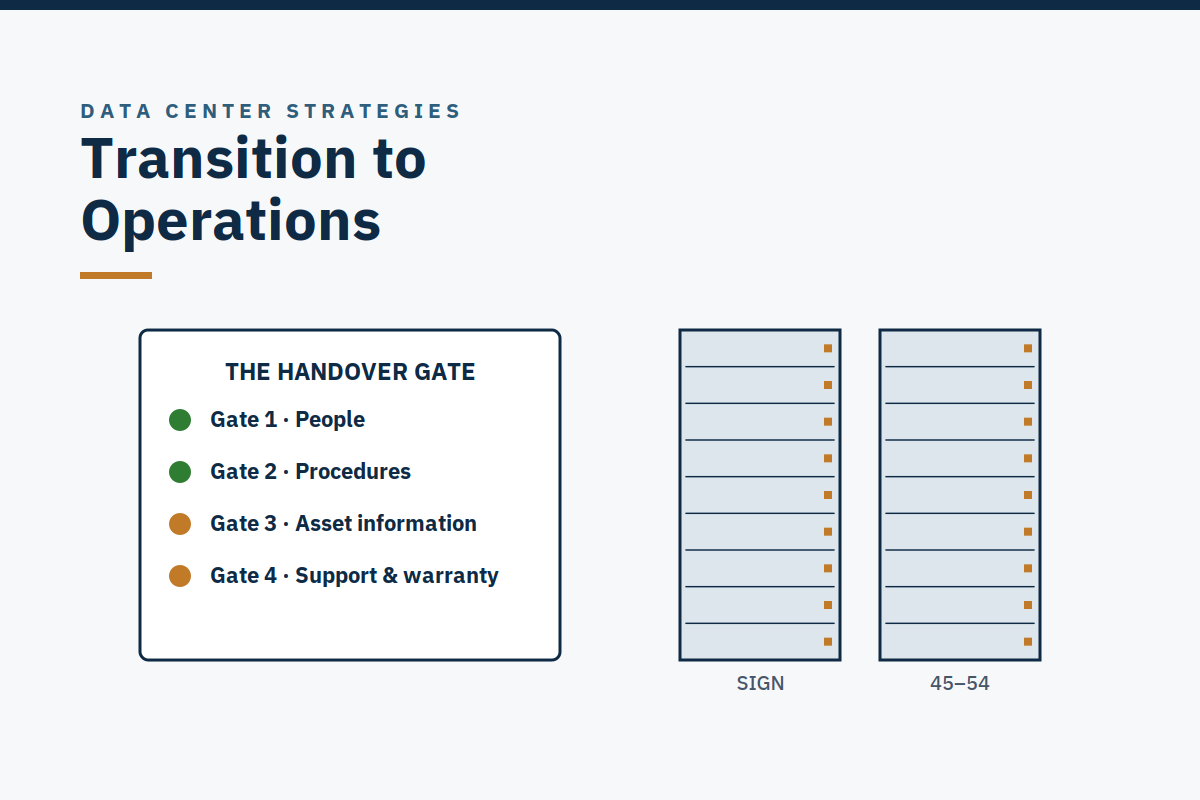
Summary: the short version. Taking over a new data center is a signing moment, not a ceremony: one signature transfers responsibility for a building the operations team has never owned to that team, at 3 a.m., under alarm. There is no single public operational-readiness standard to hide behind. ASHRAE Guideline 1.6P was still at first public review draft in October 2026 (VERIFIED, draft status, ASHRAE, October 2026).
This guide gives you the working method instead: four readiness pillars (People, Procedures, Asset information, Support/warranty), a 27-check Handover Gate scored 0–2 per check, eight red lines that force a "Do not sign" verdict on their own, and the three possible verdicts. Sign, Sign with conditions, Do not sign. The work that makes signing safe happens before the signature, not after it.
What is transition to operations, and why is it the riskiest seam in a data center's life?
Transition to operations is the formal transfer of a data center, or one building, or one hall, from the people who designed and built it to the people who have to operate it. It ends in a signature. Before that signature, a problem is the contractor's problem. After it, a problem at 3 a.m. is the operations team's problem, and the team that takes it over has never owned or operated a data center before, at least, not this one.
The equipment is new, the control sequences are unproven under real load, and the procedures were written by people who have not yet run them.
That is the condition the signature creates, and it is why the transition is the riskiest seam in a data center's life. It is also a seam the industry has not standardized. Commissioning is covered generically by ASHRAE Guideline 0 and Standard 202, and the data-center-specific ASHRAE Guideline 1.6P was only at first public review draft in October 2026, not final, so do not cite it as a published standard (VERIFIED, draft status, ASHRAE, October 2026).
Uptime Institute's Tier Standard: Operational Sustainability and its Management & Operations Stamp of Approval assess operations, but they are assessments, not a step-by-step readiness checklist an operator can download and follow. Only Uptime Institute awards Tier, Operational Sustainability, and the M&O Stamp of Approval. No consultancy can award or guarantee one, and this guide does not promise one.
The doctrine that underpins everything in this guide comes from published project-acceptance practice: "No responsibility for 'completed' construction areas should be taken on by the site operational management team(s), without the formal acceptance of the project, area or building according to pre-defined criteria… Ideally the core site operations staff should be present during commissioning" (VERIFIED, secondary, practitioner doctrine, Future-tech project-acceptance practice, 2020, updated 2024). Read that sentence twice. The first half is the gate: pre-defined criteria, formal acceptance.
The second half is the timing: the operations team should be present during commissioning, not hired after it. Most handover failures trace back to violating one of those two halves.
The point is that handovers are happening at a scale the industry has never attempted before, and each one is a signing moment with the same risks. How many handovers are we talking about? That is an estimate, not a count. ESTIMATE, bottom-up: CBRE counted 7,481 MW under construction in its eight primary North American markets in H1 2026, 80.4% preleased (VERIFIED, CBRE, North American Data Center Trends Report, H1 2026, published August 2026).
Dividing by AFCOM's 2026 survey average facility size of about 38 MW gives roughly 150–375 handover events, with the endpoints assuming average site sizes of about 20–50 MW (central case about 197, at the survey average of about 38 MW) (ESTIMATE, bottom-up). This is our estimate, not a published market size. The point is not the exact number.
Why do handovers go wrong?
Handovers go wrong in a recognizable pattern. If you can name the pattern, you can check for it before you sign.
Integrated systems testing is compressed, deferred, or run at partial load. Level 5 testing needs the whole plant, full load banks, and an uninterrupted block of time. A delayed project has none of those to spare, so L5 is the level schedule pressure attacks first, and the failures it would have caught become first-year operational problems instead. See How much commissioning is enough? below.
The turnover package is incomplete. As-built drawings that show the building as designed, not as installed. An asset list that does not match what is actually on the floor. Commissioning records that stop at component tests. No planned maintenance schedule. Operations is asked to run a building it cannot fully describe.
The operations team was hired late or was not present during commissioning. The doctrine says the core team should be present during commissioning. In practice the team is often hired late, arrives after the testing is done, and is asked to learn the building while it is already in service. That is not a staffing delay. It is a readiness failure, because the team's first encounter with the plant is a live one.
There is no drilled emergency-procedure library. Procedures exist on a shelf, or do not exist at all, and the top emergency procedures have never been walked in the field or drilled under alarm. This matters more than most owners realize, because procedures are the dominant preventable cause of outages. In Uptime Institute's Annual Outage Analysis 2026 (May 2026), failure to follow established procedures was the leading driver of human-error outages at 59% (n=199) (VERIFIED, Uptime Institute, Annual Outage Analysis 2026, May 2026, Fig. 14).
In the 2026 analysis, 92% of respondents said human error was at least a minor contributor to their most recent impactful outage (VERIFIED, Uptime Institute, Annual Outage Analysis 2026, May 2026, Fig. 13, Resiliency Survey 2026). Human error is a contributing factor here, not a root cause, and the 92% must never be read as 92% of outages caused by human error.
A handover that delivers a building without a drilled procedure library is delivering the single largest known outage risk, unmitigated.
Sustained overtime is already above ten percent. Uptime practitioner guidance states that sustained overtime at or above 10% "correlates very strongly to increased rates of incidents, including outages and even serious injury or loss of life" (VERIFIED, secondary, practitioner guidance, Uptime Institute, Top 14, February 2021). If the rota only works on overtime before the building is even live, it will not work after.
Redundancy exists on paper only. Equipment sitting in bypass, a breaker racked out and never racked back, a single common dependency that testing never fault-injected. A spare that has never been proved is a hope, not redundancy.
For a liquid-cooled site, the coolant specifics are missing. No lab-verified coolant specification at turnover, no air-management plan, no passivation records, no pressure evidence, no warranty-responsibility matrix between the cooling vendor, the IT vendor, and the installer. See the Liquid Cooling Operations guide for what "ready" means on a liquid-cooled hall.
The Handover Gate: Sign, Sign with conditions, or Do not sign
The Handover Gate is the scored, evidence-based decision at the signing moment. It is the consultant's own method, not a standard, no public operational-readiness standard exists (see above). Label it as such wherever it is used: ESTIMATE, consultant's method. It is applied per area or building, and re-applied after any material change. A site may pass for one hall and fail for another.
The gate scores 27 checks, 0–2 each (0 = absent / not evidenced, 1 = partial / in progress with a named owner and date, 2 = complete and evidenced), for a maximum of 54. Score only what the assessor has seen, a document read, a test record checked, a drill observed. "The contractor says it is done" scores 0.
A deficiency formally accepted in writing by the owner, with a named owner and date, scores 1, not 2, acceptance is not completion. The issue log follows strict discipline: severity-classified, owned, and independently verified closed, not self-certified by the party that created it.
| Band | Verdict | Meaning |
|---|---|---|
| 45–54, no red lines | Sign | Take responsibility. Record residual observations in the issue log with owners and dates. |
| 32–44, no red lines | Sign with conditions | Sign only with a written conditions schedule: each condition named, owned, dated, with a stated consequence if it slips (including, where appropriate, a re-gate date). Conditions are commitments, not "we'll get to it". |
| 0–31, or any red line | Do not sign | Do not take responsibility for the area. State the blocking items (the five most material first if there are more than five), the evidence that would clear each, and the re-gate date. |
Source: Data Center Strategies consulting method, Handover Gate §2.1 (consultant's own method).
"Sign with conditions" is a real verdict, not a polite way of saying yes. The conditions are the list, and they have owners and dates.
The eight red lines: any one forces "Do not sign" on its own
A site that scores 45–54 but trips any red line is Do not sign. The red lines override the scored band.
- IST (L5) incomplete, compressed to partial load, or run without full load banks. Unless the unproven scenarios are formally accepted in writing by the owner, with the risk recorded.
- Open critical items on the issue log, or deficiencies "deferred to post-occupancy" without a formal, owned, dated acceptance.
- No authorized person available for a critical task the first week will require, for example, no one authorized to operate the UPS bypass, or no one authorized for the CDU loop, or the operations team not hired, not present during commissioning, and not trained or authorized on the systems they must operate, with no staffed alternative evidenced.
- Sustained overtime at or above 10%, or a rota that depends on it (see V13 above).
- Redundancy on paper only: equipment in bypass, a breaker racked out and never racked back, or a single common dependency (one CDU loop, one chiller controller, one BMS network) that IST never fault-injected and that would defeat redundancy, with no mitigation evidenced.
- No leak-response capability on a liquid-cooled site (no detection proven, no EOP, no isolation procedure, no coolant spill kit or containment).
- No controlled EOP for a predicted failure mode the site's own design makes credible, including loss of power and loss of cooling, or an EOP that has never been field-validated and cannot be validated before signing.
- Handover package materially incomplete: no as-builts as installed, no asset register, and no PM schedule, together, not one item alone.
Formal written acceptance by the client decision-maker, with the risk recorded, cures red lines 1 and 2 only, and the gate then becomes Sign with conditions for the accepted item. It does not cure red lines 3–8: for those, the evidence or capability must exist. The client decision-maker named in the engagement decides whether to sign. The assessor recommends the gate and evidences it; he does not sign the handover on the client's behalf and does not override the client's decision.
The four pillars of readiness, in detail
People: enough qualified, authorized staff, hired early enough
The checks: core operations staff hired and in post before turnover, present during commissioning (attendance evidenced, not asserted). An authorization matrix that is complete. Every critical task has a named authorized person, and no task depends on one individual. A shift rota published for the first 90 days, with cover for absence and a fatigue/overtime rule. Every operator has completed system training for the systems they will operate, and EOP drills for the Top-10 scenarios. A duty-manager and escalation chain named, with deputies, and tested by a live call-out, not a phone list on paper.
Vendor and field-service-engineer access and release rules agreed: who may touch what, under which MOP, with whose release. Incident-command roles named (incident lead, scribe, comms, technical lead) and rehearsed. Training here does not mean a classroom course. It means system training during functional testing, full-facility rehearsals during integrated systems testing, and emergency-procedure drills in the field after energization. A certificate does not prove a technician can run this plant's procedures under load. Only a drill does.
For how operator capability is actually built once the team exists, curiosity, psychological safety, and seeing the whole picture as a control-room team rather than a single operator, see Case Study 6: Building Operator Capability.
Procedures: a controlled library covering routine, planned, and emergency work
The checks: a SOP library covering every routine operation the first 90 days will require (rounds, shift handover, start/stop, transfer tests, coolant checks). A MOP library covering every planned intervention on critical plant in the first 90 days, each with hold points, a back-out plan, and abort authority. An EOP library covering the Top-10/15/20 predicted failure modes, field-validated after energization. Document control: one procedure per document, version, owner, review date, and a single controlled copy, no photocopied superseded versions in the control room.
Alarm response linked: every alarm that can fire has a named procedure or a named "no action, monitor" disposition. Change control: no setpoint, sequence, or procedure change without review, approval, and a return-to-service check.
The procedure library is covered in full in the SOP / MOP / EOP guide. The short version: a SOP is how routine work is done, a MOP is a detailed step-by-step plan for one specific job that can affect critical load, and an EOP is the pre-authorized response to a predicted failure. Confusing them is the first failure.
Asset information: the operator can find, identify, isolate, and maintain every asset
The checks: as-builts as installed (single-lines, cooling schematics, controls architecture) with red-line mark-ups closed or formally accepted. An asset register complete in the CMMS/DCIM and reconciled to the installed plant (nameplate data, serial numbers, firmware versions). Commissioning records through L5 IST complete, including the concurrent-maintenance demonstration, removing a component or path for planned maintenance without affecting IT, and re-test after changes. An issue log with no open critical items. A PM schedule stood up, with every asset's next due date, procedure, and named performer. Critical spares agreed and located.
The Sequence of Operations record, showing control sequences, point-to-point, alarm/setpoint, manual override, failure-mode/recovery, and sensor calibration were verified against design intent by the commissioning authority or engineer of record (the assessor reviews that record and cites it, he does not perform or witness the test).
The minimum handover package, from the same practitioner doctrine cited above, is: an authorized Practical Completion document plus an agreed snagging list; a complete and accurate asset list; the full commissioning program completed through IST with records updated; all systems proved working together and maintainable, with maintenance schedules and procedures; all hard and soft O&M, health-and-safety, and CDM documentation in full before operations takes responsibility; acceptance testing by operations to confirm maintainability; and operations must not take management responsibility until properly trained and satisfied the systems work and can be maintained.
Support and warranty: every system has a named owner, a boundary, and a response path
The checks: a warranty-responsibility matrix signed by all parties, including the liquid-cooling boundary (cooling vendor vs IT vendor vs installer). Warranty expiry dates scheduled, with the 10-month review date set. Vendor SLAs and OLAs on file with response times, and escalation contacts tested. For liquid-cooled sites, a coolant specification lab-verified at turnover (composition, chemistry, conductivity, inhibitor. ASHRAE TC 9.9, May 2026, TCS Coolant Integrity and System Readiness Best Practices). Leak-detection coverage. The commissioning/IST record shows layered detection was proven in the field, and the leak-response EOP has been drilled. Controls fallback.
The commissioning/IST record shows the loss-of-supervisor test, single-controller/switch/control-power failure-domain test, time-sync and sequence-of-events test, and historian/store-and-forward test were passed. And a seasonal-transition plan for the first seasonal change the site will face, with pre-season checks.
How much commissioning is enough? L0–L6 and IST
Commissioning is the process that is supposed to prove a data center works before operations takes it over. The levels, in the working definitions used on this site (labels vary by project, ask the commissioning agent to map their numbering to these in writing):
- L0: requirements. The Owner's Project Requirements and the Basis of Design are defined and aligned. If L0 is vague, every level after it tests against a moving target.
- L1: factory acceptance testing. Equipment tested at the manufacturer, before shipment, as a unit. Necessary, and not sufficient: a unit that passed in the factory can still be installed wrong.
- L2: site acceptance and static testing. Equipment arrived complete and undamaged, installed correctly, safe to energize. Checklists, torque marks, point-to-point wiring checks. The operator's interest is simple: be present.
- L3: pre-functional testing and startup. Installation checklists, energization, alarms, trips, and interlocks, system by system. Controls work at this level is point-to-point testing, every sensor, every valve, every breaker position proved from the field device to the screen.
- L4: functional performance testing. Each system performs as designed, on its own, at rated conditions, in every mode: normal, failure, transfer, alarm, and recovery. This is where the operator's system training should happen.
- L5: integrated systems testing (IST). All systems ride a simulated failure together, at design load, utility loss, generator start, UPS and transfer, cooling failure, the "pull-the-plug" test, run with load banks, instrumentation, communications, and a safety plan, with issues resolved or formally accepted by the owner before turnover. This is the level that proves the building, not the components. A UPS that passed L4 and a generator that passed L4 can still fail together at L5, because the handoff between them only exists when the systems run together.
- L6: post-occupancy / seasonal testing. Commissioning continues up to one year post-occupancy: deferred and seasonal testing, optimum-operation adjustment, warranty review, lessons learned (VERIFIED, Data Center Knowledge / Vertiv; GATE Energy L6 definition). IST cannot fully simulate seasonal variation, real IT load profiles, or the control drift that appears once a loop reaches steady-state temperature under heavy load. That is not a failure of IST. It is the reason the first year needs a watch as well as a handover.
What should an operator actually do with this? Four things. First, witness, rather than receive. Attend L4 and L5. Watch the transfer as it would actually happen, with the engine running under load. A generator test that records a no-load run as a load test proves nothing about whether the generator will carry the building. Second, ask for the failure modes as well as the passes. What was fault-injected, at what load, and what happened? A test that never injected a fault never proved redundancy. Third, own the issue log.
Issues from L5 must be classified by severity, assigned an owner, and independently verified closed, not self-certified by the party that created them. Fourth, know what commissioning does not do. It does not train your team, it does not write your procedures, and it does not operate the building for its first year. Those are operations' jobs, and they start before turnover, not after it.
Worked example: what the Gate catches that a signing party does not
The pattern above is not theoretical. Case Study 1: Transition-to-Operations Readiness is a case study drawn from the author's operating experience that walks through a handover where the signing happened, a signing party, near-instantaneous turnover, and the readiness work that followed. Retrospectively scored against the Handover Gate, the site stood at 26 out of 54 at signing and 44 out of 54 after 90 days.
Those scores are ILLUSTRATIVE retrospective reconstructions, the Gate did not exist at the time, but the underlying facts are as recorded in the author's account: the team was hired in advance, the procedures were prepared before turnover, and the first 12 months still brought infant mortality, seasonal transitions, and chiller tuning problems. Read the case study for the full account; the lesson for this guide is the shape of it. A signing party is not a handover.
Readiness is four pillars, scored, with red lines, before anyone signs, and the gap between 26 and 44 is ninety days of work that should mostly have happened before the signature.
What the first 90 days after signing look like
Signing is not the end of the transition. It is the start of the first year, and the first 90 days have their own shape. The full treatment is in the First 12 Months After Turnover guide; the outline is:
- Baselining (first 30 days). The first month establishes the baseline for every trended variable. Normal is defined by the plant's own data, not by a vendor brochure. Baselines are set per system and per mode, normal, economizer, transfer, maintenance, and re-baselined after any material change.
- Gate conditions close-out. Every "Sign with conditions" item has an owner and a date. Close them on schedule, or re-gate. A condition that slips without a consequence is not a condition.
- Failure-log triage. Log every failure with age and hours, batch and serial, and operating conditions. Separate manufacturing defects from installation errors from unproven control sequences, because each has a different owner and a different fix.
- Procedure and drill catch-up. Any EOP that was not drilled before signing is drilled now, in the field, under alarm, not as a tabletop discussion.
- First seasonal change. If the site's first seasonal transition falls inside the first year, it is run as a planned, staffed event with a pre-season checklist, not as a background mode change.
When to ask for help: Transition-to-Operations Readiness
Some owners run the Gate themselves, with their own operations team. Others want an independent operator's judgment before the signing moment. Someone whose duty is to the party taking the risk, not to the contractor closing the issue log. That is the first of Data Center Strategies' three offers: Transition-to-Operations Readiness, an independent readiness assessment before the signing moment, covering people, procedures, asset information, and support arrangements, engaged ideally from L4 so the team is present during commissioning.
The gate must land before the signing moment, with time to act on "Sign with conditions". A gate delivered the day before signing is a finding about the schedule, not a deliverable met on time.
Indicative scope anchors (not a price for any specific site; a fixed price is only quoted after scoping, never on a first call): Small $18,000 (2–3 weeks: document and plant review, site walk with the operations team present, staffing and qualification spot-check, handover-package completeness check); Medium $23,000 (3–4 weeks: plus full procedure-library review, maintenance-program and asset-register check, vendor and warranty boundary review, qualification and authorization matrix review); Large $28,000 (4–6 weeks: plus liquid-cooling readiness check, drill observation of priority EOPs, seasonal-transition plan outline).
A multi-building campus, phased handover, mixed cooling across halls, or immersion cooling is scoped individually, not forced into a tier to hit a price. These are anchors from the consulting playbook; they are not a quotation.
What this offer does not do, stated plainly: it does not award or guarantee Tier or M&O certification (only Uptime Institute does that); it does not provide engineering design or a PE stamp; it does not re-perform commissioning or witness or sign commissioning test records; it does not provide 24×7 cover or operate the site; it does not perform or direct licensed or energized work; and it promises no zero-outage guarantee or guaranteed uptime figure. If you need any of those, you need a different provider, and a readiness reviewer should say so.
To start a conversation about a readiness review, see the contact page: a short conversation, not a pitch, and no obligation. Tell us about your project and we will scope it together; no engagement starts before a written scope is agreed.
Questions owners ask before signing
Who decides whether we sign? The client decision-maker, the owner or operator taking the risk, decides. The readiness assessor recommends the gate verdict and evidences it. He does not sign the handover on the client's behalf and does not override the client's decision. Record the decision, the date, and who made it.
Can we sign one hall and not another? Yes. The Gate is applied per area or building, and re-applied after any material change. A site may pass for one hall and fail for another. Phased handover is normal on a campus; what matters is that each phase has its own gate, not one signature for the whole campus.
What if the contractor says the issue log is closed? Ask who verified closure. The discipline in this guide is that issues are independently verified closed, not self-certified by the party that created them.
What if we are already behind schedule and L5 was compressed? Then the gate has a specific answer for that: red line 1. Either the unproven scenarios are formally accepted in writing by the owner, with the risk recorded, which cures the red line and makes the gate "Sign with conditions" for that item, or the verdict is "Do not sign" for the affected scope. Schedule pressure is real, and it is also the reason L5 exists: the failures it would have caught become first-year operational problems instead.
Does the Gate replace the commissioning authority? No. The commissioning authority plans and witnesses commissioning and owns the pass/fail call. The readiness assessor reviews the commissioning authority's evidence from the operator's side and judges whether operations can take responsibility. Those are different jobs, and confusing them helps no one.
Further reading
Further reading: The Signing Moment: What "Ready for Operations" Really Means, L1–L5 and IST, Explained for the Operator Who Has to Live With the Result, and How to Staff a New Data Center Before Go-Live.
Sources
Sources for the figures cited in this guide.
- Uptime Institute, Annual Outage Analysis 2026 (Keynote Report 201), May 2026, failure to follow established procedures the leading driver of human-error outages at 59% (n=199, Resiliency Survey 2026, Fig. 14); power the leading cause of impactful outages for the fifth consecutive year. VERIFIED.
- Human error as at least a minor contributor for 92% of respondents’ most recent impactful outage (Fig. 13), and failure to follow established procedures as the leading driver of human-error outages at 59% (Fig. 14, n=199): Uptime Institute, Annual Outage Analysis 2026, May 2026, Resiliency Survey 2026.
- Uptime Institute, Top 14 (Burgess), February 2021, sustained overtime at or above 10% "correlates very strongly to increased rates of incidents, including outages and even serious injury or loss of life". VERIFIED, secondary: practitioner guidance.
- ASHRAE Guideline 1.6P, Application of the Commissioning Process to Data Centers, at first public review draft in October 2026, not final. VERIFIED, draft status. Re-check ASHRAE's public-review page before any citation.
- Future-tech project-acceptance practice, 2020, updated 2024, "No responsibility for 'completed' construction areas should be taken on by the site operational management team(s), without the formal acceptance of the project, area or building according to pre-defined criteria… Ideally the core site operations staff should be present during commissioning." VERIFIED, secondary, practitioner doctrine.
- CBRE, North American Data Center Trends Report, H1 2026, published August 2026, 7,481 MW under construction across eight primary North American markets, +24.8% year-on-year, 80.4% preleased. VERIFIED.
- AFCOM, State of the Data Center 2026 (10th edition, early 2026): average facility size approaching 38 MW. VERIFIED.
- ASHRAE TC 9.9, TCS Coolant Integrity and System Readiness Best Practices, Technical Bulletin, May 2026, four ways a direct-to-chip technology cooling system can drift invisibly at commissioning and surface as damage months later. VERIFIED.
- Data Center Knowledge / Vertiv; GATE Energy (L6 definition), commissioning continues up to one year post-occupancy; L6 is post-occupancy / seasonal testing. VERIFIED.
- Data Center Strategies consulting method, Handover Gate §2.1, 27-check checklist, red lines, gate bands (consultant's own method, ESTIMATE, consultant's method).
- Case Study 1: Transition-to-Operations Readiness (case study, November 7, 2026). Handover Gate scores 26/54 at signing and 44/54 after 90 days are ILLUSTRATIVE retrospective reconstructions.
- Uptime Institute's own caution, Annual Outage Analysis 2025: "Data relating to outages should be treated skeptically. All methodologies… are subject to uncertainty, partly because of a lack of transparency and reliable reporting mechanisms." VERIFIED, method note, quoted when quoting outage percentages.
Takeaway. The signing moment is the one decision in a data center's life that cannot be undone by working harder afterwards. Check the four pillars, People, Procedures, Asset information, Support/warranty, against evidence you have seen, score the 27 checks, honor the eight red lines, and take one of three verdicts: Sign, Sign with conditions, or Do not sign. If the answer is no, do not sign yet. The building will wait. The first failure will not.
Next: read The First 12 Months After Turnover for what the year after signing actually brings, and SOP / MOP / EOP. Procedures That Hold Under Pressure for the library the Gate checks.