
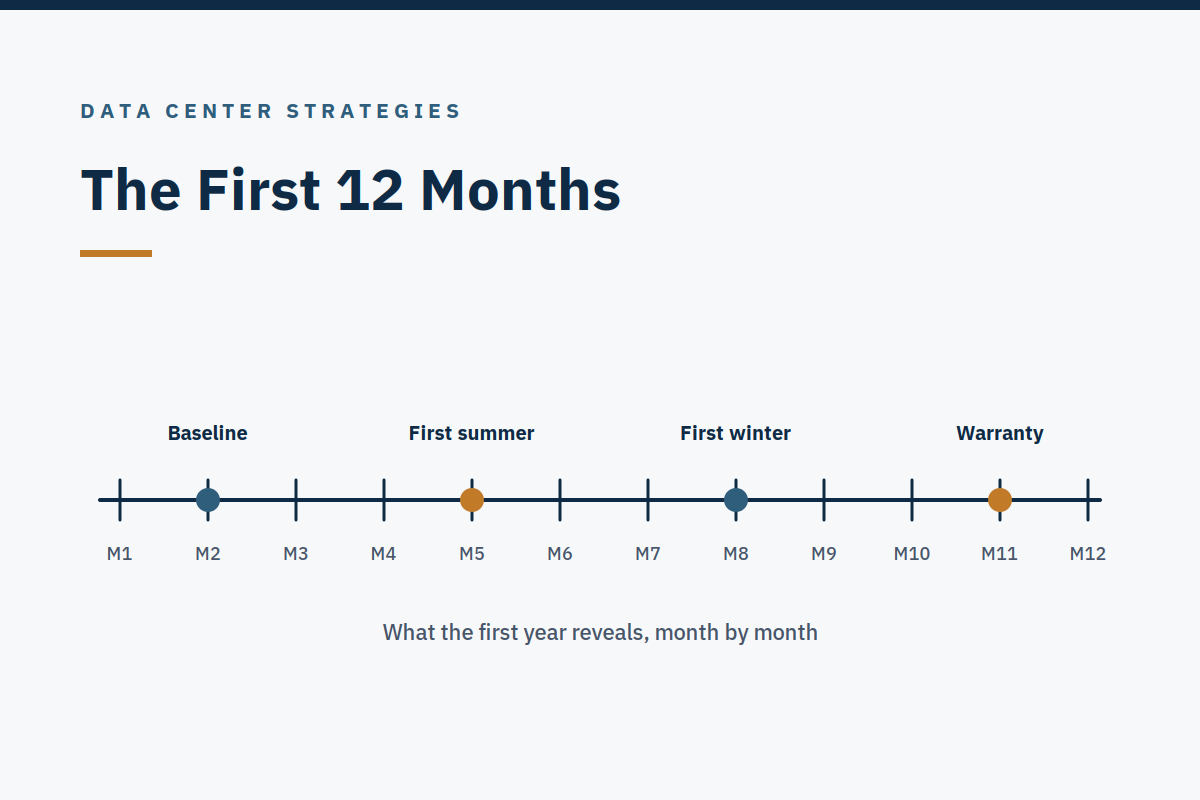
What happens in the first 12 months after a data center is handed over? The honest answer is: the things integrated systems testing could not simulate. A cluster of early failures. A seasonal cooling transition the plant has never made under real load. Chiller tuning problems that only appear when the control sequences run at steady-state temperature under the actual operating profile. And a warranty clock that runs out whether or not anyone has used it.
This article closes the opening series by returning to the signing moment with a first-year watch plan.
Commissioning continues for a year
The first misconception to clear up is that commissioning ends at handover. It does not. Commissioning continues up to one year post-occupancy: deferred and seasonal testing, optimum-operation adjustment, warranty review, and lessons learned (VERIFIED, documented commissioning practice, Data Center Knowledge / Vertiv; post-occupancy and seasonal testing is Level 6). The building is finished a year later, after it has seen both seasonal extremes under real load.
The reason is straightforward, and it is a method statement rather than a survey finding: integrated systems testing cannot fully simulate seasonal variation, real IT load profiles, or the control drift that appears once a loop reaches steady-state temperature under heavy load. A test can prove the plant at design load on the day of the test. It cannot prove the plant in July, under a load profile that did not exist in March, with sensors that have drifted since they were calibrated.
The first year is where that proof happens, in service, with real load, and with the operations team holding the risk.
Infant mortality: a cluster, not a percentage
The first pattern of the year is the cluster of early failures. New plants see early failures from a mix of manufacturing defects, installation errors, and unproven control sequences, which is why burn-in, integrated systems testing, and a first-year watch matter. No single bathtub-curve percentage holds for facility plant. The USENIX study of about 100,000 disks found "rather than a significant infant mortality effect, we see a significant early onset of wear-out" (VERIFIED, USENIX disk study, n≈100,000), and for facility equipment the documented early-failure mechanism is more often design, installation, or startup deficiency and control or calibration error than component bathtub mortality. The dated "nearly 70% of early failures traceable to design, installation, or startup" figure (Donato, 2013) is UNVERIFIED today.
The operator's job in the first months is therefore triage, not surprise. Every failure gets logged with its age and hours, its batch and serial number, and its operating conditions, because each cause has a different owner and a different fix. A manufacturing defect is a warranty claim. An installation error is a contractor's problem. An unproven control sequence is a tuning task. A log that records only "pump failed" tells the operator nothing; one that records age, hours, batch, and conditions tells them which cause they are dealing with, and whether the sister unit is next.
One operator's experience, labeled as such rather than as a statistic, illustrates the pattern: the first 12 months at a newly constructed, liquid-cooled AI facility brought a cluster of early equipment failures alongside the seasonal and tuning problems below (ESTIMATE, author's account; one operator's experience, not an industry statistic). The lesson is the discipline: log everything, classify it, and use the log as warranty evidence before the clock runs out.
The seasonal transition the test never made
The second pattern is the seasonal transition. A chiller, a cooling tower, a dry cooler, or an economizer mode that was never tested at the ambient the first hot season brings is unproven at exactly the moment it is needed most. The transition exposes capacity shortfalls and hunting at the changeover, a chiller that short-cycles, a staging sequence that fights the load, an economizer that changes over at the wrong point. This is failure mode F2 in the first-year catalog: the first hot season, or the first cold snap, exposes a mode never tested at that ambient.
The sharp end of this pattern, a seasonal transition that became a complete loss of cooling, is told in full as Case Study 5, The Cascading Loss of Cooling. The general point stands on its own: in a cold-plate hall, chip thermal limits can be reached in seconds once flow or cooling is lost (VERIFIED, Uptime Institute; one cited case: CDU pump failure to throttling in as little as 23 seconds, case-specific).
The practical consequence is that a seasonal transition should be run as a planned, staffed event, not a background mode change. Two weeks before the expected changeover, and again two weeks after: pre-season checks, the transition run with staff present, and a trend review against the baseline afterwards. Any hunting, short-cycling, or staging fight is logged as a tuning action, and the lessons are recorded for next year's transition.
The handover package should have contained a seasonal-transition plan for the first seasonal change the site will face, if it did not, that is a gap to close in the first month, not a discovery to make in July.
Chiller tuning and calibration drift
The third pattern is the quietest and the most easily misread: chiller tuning and calibration drift. Control sequences that were never exercised at real load, at steady-state temperature, under the actual operating profile, do not show their problems during commissioning. They show them in the first year, as a chiller hunts, short-cycles, or fails to stage; as sensors drift; as staging logic fights the load.
This is failure mode F3, and the same operator's account records it directly: chiller tuning and calibration problems in the first year that did not appear during commissioning, because the control sequences had never been exercised at real load (ESTIMATE, author's account).
The diagnostic discipline is trend over alarm. Compare the controlled variable against its setpoint and against the sister unit, and check sensor calibration before changing any setpoint. A rising approach temperature at the same load and ambient means fouling, visible weeks before a trip, and the same logic applies to a drifting sensor, a hunting valve, or a staging sequence that has drifted from design intent. Case Study 3, The Silent Compressor Failures, shows the same principle from the other side: the trend, not the alarm, revealed failures no alarm raised.
The governance point is that tuning is a first-year operations task, not a commissioning defect to argue about. Every setpoint change goes through change control, with a return-to-service check. A setpoint changed on a hunch, without a record, is a change that never happened, until it causes an outage.
The warranty clock
The fourth pattern is the one with a deadline. The warranty clock runs from handover, and the month-10 warranty-expiry punch-list is the mechanism that makes it useful. At month 10, not month 11: a failure-log review classifying every failure in months 0–10 as a warranty claim, a vendor defect, an installation defect, an operations matter, or wear, with every warranty-classified failure carrying a claim reference or a written reason it was not claimed. An issue-log sweep, so nothing warranty-covered is left to expire unclaimed.
Seasonal evidence: the plant has now seen, or is scheduled to see, both seasonal extremes, and any mode never exercised is listed as a residual risk, not assumed to work. Coolant evidence for liquid-cooled sites, controls evidence, and a punch-list with an owner, a due date before warranty expiry, and a stated consequence if it slips past expiry.
The failure log matters from day one: a failure never logged cannot be claimed, and the watch exists to catch drift early while the warranty clock makes the contractor fix it.
The first-year watch plan
Pulling the year together, the watch plan is simple enough to write on one page. Baseline everything in the first 30 days, normal is defined by the plant's own data, per system and per mode, not by a vendor brochure. Triage every failure against the first-year catalog: infant mortality, seasonal transition, tuning and calibration drift, cascading loss of cooling, alarm floods, warranty-boundary disputes, redundancy erosion, coolant drift, controls loss, maintenance-induced failure, generator or transfer failure on demand, and fire, leak, or water ingress interacting with cooling.
Keep a redundancy board that records the actual redundancy state of every system, every shift, because a plant that is 2N on paper and N on a Tuesday afternoon is N, and the board is how the shift team knows. Run each seasonal transition as a staffed event. And issue the month-10 punch-list on time.
Then return to the signing moment. The question asked at the signing moment was whether this team, with these procedures, on this plant, could hold the three jobs, power in, heat out, nothing down, through the first failure. The first year is the answer to that question, delivered one failure at a time. If the gate was done well, the year is a series of caught problems. If it was not, the year is the lesson, and the warranty clock is the deadline for learning it.
Takeaway
The first year after handover is when the building is truly proved: early failures cluster from manufacturing defects, installation errors, and unproven control sequences, not from a single bathtub percentage. Seasonal transitions and chiller tuning problems appear only under real load, so run each transition as a staffed event and trend the controlled variables against their setpoints. Log every failure with age, hours, batch, and conditions, and issue the month-10 warranty punch-list on time, the clock runs out whether or not anyone has used it.
Further reading
- First 12 Months After Turnover guide, what goes wrong in the first year, and how to catch it early.
- Case Study 2: Post-Turnover Operational Watch, what drifts in the first 12 months, and how a watch catches it earlier.
- Contact, start a conversation about a first-year watch; a conversation, not a pitch.
Sources
- Commissioning continuing up to one year post-occupancy: documented commissioning practice, Data Center Knowledge / Vertiv.
- Disk failure patterns in a population of about 100,000 drives: Pinheiro, Weber, and Barroso, Failure Trends in a Large Disk Drive Population, USENIX FAST '07.
- Seconds-scale chip thermal limit, with the 23-second figure flagged as case-specific.
- The author's own cases are the author's account, not a statistic.
- The Donato 2013 "nearly 70%" figure is not verified against a second source and is not relied on here.
Published Saturday, October 17, 2026. By Scott Stillings. Scott spent more than twenty years in critical infrastructure operations, as a submarine reactor operator in the U.S. Navy, as a commercial nuclear operator and senior-reactor-operator-certified instructor, and as a critical operations manager for a large hyperscale data center campus. He is the author of Where AI Lives: Inside the Hyperscale Data Centers Powering the AI Boom (Inside Hyperscale).