Drawn from the author's operating experience. Client details are anonymized.
The turnover case: what was missing at handover, what the Handover Gate would have caught, and what was built in the first 90 days
Offer: Transition-to-Operations Readiness (Data Center Strategies) Date: 7 November 2026
The Handover Gate method used in this case is the consultant's own method, not an industry standard. There is no single public operational-readiness standard: ASHRAE Guideline 1.6P was only at first public review draft in October 2026, VERIFIED, draft, and Uptime Institute's Operational Sustainability and M&O Stamp of Approval are assessments, not a step-by-step readiness checklist.
1. Situation
A newly constructed, new-design, liquid-cooled AI facility was approaching turnover. The author was brought in to build the data center operation from scratch: hire the team in advance of turnover, prepare the standard and emergency operating procedures (SOPs and EOPs), and set shift-operations expectations, so that operations could take responsibility when construction and commissioning handed the building over.
Turnover itself was near-instantaneous, a signing party, after which responsibility shifted to a team that had never owned or operated a data center. That is the fact this case turns on. The team's prior experience was in the merchant marines and as power plant operators, Recorded in the author's account. Those are serious operating backgrounds, and they are not data center backgrounds.
A power plant operator understands rotating plant, watchkeeping, and procedure discipline; a merchant marine engineer understands running a plant alone at sea with no one to call. Neither had owned a data center: its electrical topology and redundancy states, its cooling loops and control sequences, its alarm and escalation discipline, or its vendor and warranty boundaries.
The facility was also new in a second sense. It was a new design, liquid-cooled, built for AI load, so there was no established operating pattern to inherit, no previous shift team to learn from, and no seasonal history for the plant. The team had to learn the building while operating it, under real load, from day one.
The following 12 months, Recorded in the author's account, brought the three things the first year of a new plant most often brings: a cluster of early equipment failures (infant mortality), seasonal cooling transitions the plant had never been through, and chiller tuning and calibration problems that had not appeared during commissioning. A cascading loss of cooling also developed over several hours during that first year, Recorded in the author's account. This case is about the handover that preceded all of that, and the 90 days that followed it.
2. What was found
The signing moment is the hinge of this case. Before it, responsibility sat with construction and commissioning; after it, it sat with the operations team, in full, with no practical way back. The work that makes signing safe therefore has to happen before the signing, not after it.
In this case, the team did a great deal of the right preparation, it was hired in advance, it had procedures, and it had shift expectations set, and the handover still left gaps. That is the normal pattern, and it is why the Gate exists: good preparation and readiness are not the same thing, and only evidence distinguishes them.
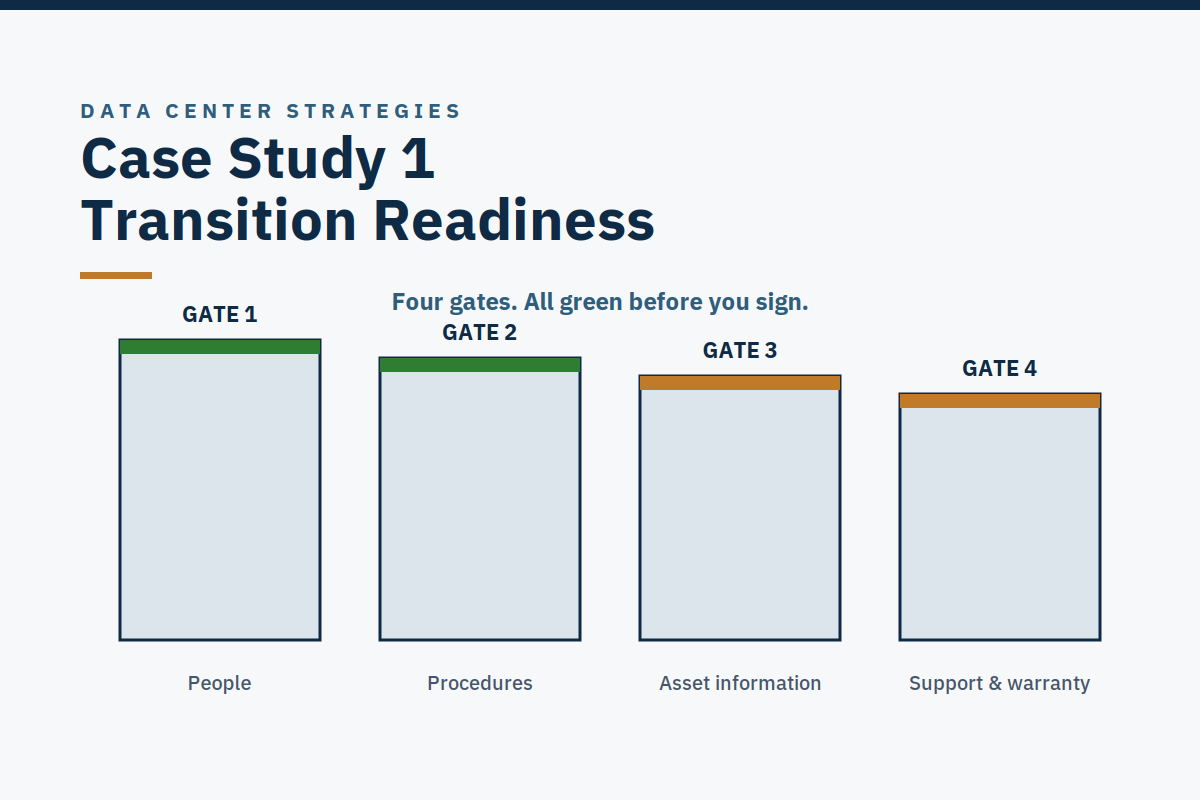
Applied retrospectively, the Handover Gate, 27 checks across four pillars, each scored 0–2, maximum 54, with an 8-item red-line list that forces "Do not sign" on its own, would have tested the handover in four places. The table below states what the author's account records, and what the Gate would have asked for as evidence. No score was taken at the time: the Gate did not exist when this handover happened, so this case applies the Gate's checks qualitatively, without a retrospective score.
| Pillar | What the account records | What the Gate would have required as evidence |
|---|---|---|
| People | Team hired in advance of turnover; shift-operations expectations set. Prior experience merchant marines / power plant operators; no member had owned or operated a data center. | Gate checks 1–7: core staff in post before turnover and present during commissioning (attendance evidenced, not asserted); an authorization matrix with no critical task depending on one individual; a published 90-day rota with absence cover and a fatigue rule; system training and EOP drills for the Top-10 scenarios; a tested escalation chain; vendor access and release rules; named incident-command roles, rehearsed. |
| Procedures | SOPs and EOPs prepared before turnover. | Gate checks 8–13: an SOP library covering every routine operation the first 90 days will require; MOPs with hold points, back-out plans, and abort authority; EOPs for the predicted failure modes, field-validated after energization; one controlled copy per document, with version, owner, and review date; every alarm linked to a procedure or a named "no action, monitor" disposition; change control for setpoints, sequences, and procedures. A procedure that has been written but never walked in the field scores partial at best, "the contractor says it is done" scores 0. |
| Asset information | A new-design plant, taken over at turnover. No record in the account of a complete as-installed handover package being verified by the operations team before signing. | Gate checks 14–20: as-builts as installed (not as designed); an asset register reconciled to the installed plant in the CMMS/DCIM; commissioning records through integrated systems testing (IST, Level 5), including the concurrent-maintenance demonstration; a severity-classified issue log with no open critical items; a PM schedule with the first 90 days scheduled; agreed critical spares; and the sequence-of-operations record verified by the commissioning authority and engineer of record. |
| Support / warranty | A new liquid-cooled design with multiple vendors behind it. No record in the account of a signed warranty-responsibility matrix before signing. | Gate checks 21–27: a warranty-responsibility matrix signed by all parties, including the liquid-cooling boundary (cooling vendor vs IT vendor vs installer); scheduled warranty expiry dates; vendor SLAs and tested escalation contacts; lab-verified coolant specification at turnover; proven leak detection and a drilled leak-response EOP; a controls-fallback record; and a seasonal-transition plan for the first seasonal change the site will face. |
Three gaps mattered most, and they are the ones the Gate is built to catch:
- Procedures existed but had not been proven on the plant. An SOP or EOP written before energization is a draft until someone walks it in the field, on the real plant, in the real state it assumes, with an operator who did not write it. Field validation happens after energization for EOPs. Until then, the team holds intentions, not procedures.
- The team had never operated this plant, or any data center, under load. Hiring in advance is necessary and was done. It is not sufficient. The Gate asks for commissioning attendance evidenced by a log, and for drills, not for a training record alone, because the first time an operator runs a loss-of-cooling EOP should not be the first time cooling is actually lost.
- The first seasonal change and the first real-load tuning had no plan behind them. IST cannot fully simulate seasonal variation, real IT load profiles, or the control drift that appears once a loop reaches steady-state temperature under heavy load. A handover with no seasonal-transition plan (Gate check 27) and no baselining plan hands the team a plant whose behavior in its first hot season is genuinely unknown.
Any one of the eight red lines forces "Do not sign" for the affected scope, regardless of the scored total. On the account as recorded, at least two red lines would have needed to be tested before signing rather than assumed away: whether any critical task in the first week had no authorized person available (red line 3, a team that has never operated a data center, with no staffed alternative evidenced), and whether an EOP for a predicted failure mode the design makes credible, including loss of cooling, had been field-validated (red line 7).
The Gate's answer in that position is not "the team is bad." It is "do not sign yet; here is the evidence that would clear each item, and here is the re-gate date."
3. What was done: the method, and the first 90 days
Framing, retrospective reconstruction. The sequence below is a retrospective reconstruction of the first 90 days, written against the method the experience later produced. The Handover Gate did not exist at the time, and no scores were taken; where a claim rests on the author's account it is labeled Recorded in the author's account, and where it is a method prescription it is stated as such. Method numbers in this section, the 27 Gate checks, the score bands, the 7-day review window, the Top-10 list, are the consultant's own method, not verified facts.
The work after turnover followed the shape the Handover Gate and the post-turnover Watch now formalize. It was not a single fix. It was a sequence: prove the procedures on the plant, establish what normal looks like, then work the failure modes the first year actually produces, in the order they appear.
Days 0–30: make the procedures real. The first month was field validation and baselining. Every EOP was walked in the field by someone other than its author, on the real plant, in the real state the procedure assumes; steps that could not be performed as written were rewritten, not annotated. The Top-10 failure modes were prioritized, loss of power and loss of cooling first, because the design makes both credible.
Baselining began at the same time: the first month establishes the baseline for every trended variable, per system and per mode, from the plant's own data rather than a vendor brochure. A baseline without a stated mode and load is not a baseline. Alarm response was linked to procedures, so that every alarm that could fire had a named procedure or a named "no action, monitor" disposition.
Days 30–60: drill, and start triaging the first failures. EOPs were drilled as injected-fault drills, not tabletop walk-throughs. A tabletop is not a drill, and the distinction matters because the skill being built is the first stabilizing action under alarm, not the discussion of it. The target used for that first action is inside 60 seconds of opening the document, [Practitioner target, AI Data Center Guide template, not a standard].
Early equipment failures were logged with age and hours, batch and serial number, and operating conditions, and triaged by cause: manufacturing defect, installation error, or unproven control sequence. The three have different owners and different fixes, and separating them is what turns a failure log into warranty evidence before the clock runs out.
Days 60–90: tune against the baseline, and prepare for the season. Chiller tuning and calibration problems were worked as a first-year operations task, not argued about as a commissioning defect: trend the controlled variable against its setpoint and against the sister unit, check sensor calibration before changing any setpoint, and route every setpoint change through change control.
The seasonal-transition plan was built for the first seasonal change the site would face, with pre-season checks run as a planned, staffed event. The redundancy board was kept every shift, the actual redundancy state of each system, not the designed state, because a plant that is 2N on paper can be N on a Tuesday afternoon, and only the board shows it.
The Handover Gate references for this work are the 27 checks themselves: People (1–7), Procedures (8–13), Asset information (14–20), Support / warranty (21–27). The Gate is applied per area or building and re-applied after any material change; a site may pass for one hall and fail for another. Its verdicts are Sign (45–54, no red lines), Sign with conditions (32–44, no red lines, with a written conditions schedule, each condition named, owned, dated, with a stated consequence if it slips), and Do not sign (0–31, or any red line).
Formal written acceptance by the client decision-maker, with the risk recorded, cures red lines 1 and 2 only (incomplete IST, and open critical items); it does not cure red lines 3–8, where the evidence or the capability must actually exist. The client decision-maker decides whether to sign. The consultant recommends the gate and evidences it; he does not sign the handover on the client's behalf.
4. Outcome as recorded in the author's account
This section is deliberately short, and deliberately qualitative. No PUE, downtime, cost-saving, or percentage-improvement figure is given, because none was recorded for publication, and inventing one would turn a case study into a false claim.
What the account records is the shape of the first 12 months: a cluster of early equipment failures alongside the seasonal and tuning problems described above, and a cascading loss of cooling that developed over several hours, Recorded in the author's account. On the cooling event, the account records one concrete detail that carries the lesson.
The site ran a closed-loop system of approximately 150,000–250,000 gallons, Recorded in the author's account (the account records roughly 200,000 gallons; the range is shown because the account gives an approximate figure, not a measured volume), and the thermal mass of that loop bought the team a minute or two of grace while chillers were restored, not the hours the volume might suggest, Recorded in the author's account.
In a cold-plate hall, chip thermal limits are reached in seconds once flow or cooling is lost, so thermal mass is a buffer measured in minutes at full load, not a ride-through. The mitigation is UPS-backed technology-cooling-system pumps and coolant-distribution-unit controls, and a drilled loss-of-cooling EOP with a first stabilizing action inside 60 seconds of opening the document, [Practitioner target, AI Data Center Guide template, not a standard].
The honest outcome statement is this: the team took over a plant it had never operated, held it through its first year, and learned it by operating it, including through a cascading loss of cooling. The procedures, the drills, the baselines, and the failure log were built during that year, not before it. That is the outcome the case can claim, and it is also the case's argument: the work should have been evidenced before the signing, because doing it under load is harder, slower, and riskier than doing it before.
5. What changed afterwards
The case is the reason the method exists, not an application of it. Four things were carried forward from this experience into the consulting method, and each is now a named part of it:
- The Handover Gate itself. A scored, evidence-based decision at the signing moment: Sign, Sign with conditions, or Do not sign, with 27 checks, a 0–2 score per check, and 8 red lines. The Gate exists because the shift at turnover is instantaneous and irreversible in practical terms; the work that makes signing safe happens before it.
- The first-12-months failure-mode catalogue (F1–F12). Infant mortality as a triage problem, seasonal-transition cooling failure, chiller tuning and calibration drift, cascading loss of cooling, alarm floods, warranty-boundary disputes, redundancy erosion, coolant-integrity drift, controls and supervisor loss, maintenance-induced failure, generator and transfer failure on demand, and fire, leak, or water ingress interacting with cooling. The first year is the blind spot because commissioning continues up to one year post-occupancy, deferred and seasonal testing, optimum-operation adjustment, warranty review, lessons learned, and IST cannot fully simulate what the first year contains.
- Incident learning, not incident blame. After any incident or near-miss: stabilize and restore using the EOP; preserve the record (trends, sequence of events, alarm log, shift log, the MOP in use); within 7 days, a structured review of what happened, what the procedure said, what the operator did, where they diverged and why, what the plant did, and what the indications showed; then owned actions with dates. The review asks what in the procedure, the training, or the plant made this the likely outcome, not who is to blame.
- The month-10 warranty-expiry punch-list. Every failure in months 0–10 classified, warranty claim, vendor defect, installation defect, operations, or wear, with a claim reference or a written reason it was not claimed; an issue-log sweep so nothing warranty-covered is left to expire unclaimed; and a punch-list issued at month 10, not month 11, with owner, due date before warranty expiry, and consequence if it slips.
6. Research and industry context
The case is one site's experience. The context below is the published evidence that the pattern it describes is general, not peculiar to one team. Every figure carries its label and its source; the bases are stated where two figures look similar but count different things.
| Finding | Figure and label | Source |
|---|---|---|
| Human error is the rising share of outages | 92% of respondents said human error was at least a minor contributor to their most recent impactful outage. VERIFIED. Uptime Institute, Annual Outage Analysis 2026, May 2026, Fig. 13, Resiliency Survey 2026. | Uptime Institute, Annual Outage Analysis 2026, May 2026. |
| Failure to follow procedures leads human-error outages | 59% of human-error outages (n=199). VERIFIED, Uptime Annual Outage Analysis 2026, May 2026. | Uptime Institute, Annual Outage Analysis 2026, May 2026. |
| Most operators believe the last incident was preventable (Category 3–5 outages) | 87% of operators believe better management and processes would have prevented their most recent incident, for Category 3–5 outages, on the Uptime survey’s own base. VERIFIED. Uptime 2025 survey PDF, different base. | Uptime 2025 survey PDF. |
| Power leads, cooling follows | Power was the primary cause of the most damaging incident for 45% of respondents who had an outage in the prior three years in 2025, rising to 56% in 2026. VERIFIED: Uptime Institute, Global Data Center Survey 2026, July 2026, Fig. 14 (base: respondents who had an outage in the prior 3 years). A different cut reports 54% of respondents citing power as the cause of their most recent impactful outage (share of respondents' most recent outage, a different base, not interchangeable with the 45% and 56% figures). Cooling accounts for ~13% of respondents' most recent impactful outage (the same most-recent base as the 54% power figure). VERIFIED, secondary: different denominators; do not present the figures as the same measure. | Uptime Institute, Global Data Center Survey 2026, July 2026, Fig. 14; CoreSite / Computer Weekly reporting of Uptime Annual Outage Analysis 2025. |
| Outages are expensive | 57% of the most recent significant, serious, or severe outages cost more than $100,000; 1 in 5 cost more than $1 million. VERIFIED, Uptime Annual Outage Analysis 2026, May 2026 (2025-survey basis; base: respondents’ most recent major outage). | Uptime Institute, Annual Outage Analysis 2026, May 2026. |
| Hiring is the constraint | 53% of operators report difficulty finding qualified candidates for open roles, up from 46% in 2025 (REPORTED: Uptime Institute, Global Data Center Survey 2026, July 2026, Fig. 17; n=607 in 2026 versus n=650 in 2025, via a reputable secondary summary, primary not inspected). The biggest skills gaps are electrical at 38%, junior and mid-level operations at 38%, operations management at 35%, and mechanical at 34%. | Uptime Institute, Global Data Center Survey 2026, July 2026, Fig. 17, via a reputable secondary summary (primary not inspected). |
| Overtime is a risk factor | Sustained overtime at or above 10% correlates very strongly with increased rates of incidents, including outages and serious injury. VERIFIED, secondary. Uptime Top 14 practitioner guidance, Feb 2021. | Uptime Institute, Top 14 Considerations for Addressing Data Center Facilities Management Risks, Feb 2021. |
| No readiness standard exists | ASHRAE Guideline 1.6P was only at first public review draft in October 2026. VERIFIED, draft, not final. | ASHRAE Guideline 1.6P public review draft, Oct 2026. |
| Commissioning runs into the first year | Commissioning continues up to one year post-occupancy: deferred/seasonal testing, optimum-operation adjustment, warranty review, lessons learned. VERIFIED, practitioner and vendor sources. | Data Center Knowledge / Vertiv commissioning guidance; Ethyco 10-month review. |
| How fast cooling loss bites | In a single cited case, a CDU pump failure led to throttling in as little as 23 seconds. VERIFIED for the seconds-scale claim; the 23-second figure is a single cited case, not a general rule | Single cited case in the consulting method's source material. |
| What the handover doctrine says | "No responsibility for 'completed' construction areas should be taken on by the site operational management team(s), without the formal acceptance of the project, area or building according to pre-defined criteria… Ideally the core site operations staff should be present during commissioning." VERIFIED, secondary, practitioner doctrine. | Future-tech, Data Center Project Acceptance and Operational Reporting, 2020, updated 2024. |
Two claims are deliberately not used in this case. The dated statement that nearly 70% of early equipment failures trace to design, installation, or startup deficiencies (Donato, 2013) is UNVERIFIED today and is not quoted in client-facing material. And no market-size figure for transition-to-operations consulting is cited, because none was found in public sources and none is invented.
7. What a reader can take away, and how the offer maps to it
If you are approaching a signing moment, take these five things from this case:
- Treat the signing as a decision, not a ceremony. Responsibility transfers in an instant. Score the handover against pre-defined criteria before that instant, per area or building, and be willing to hear "do not sign."
- Ask for evidence, not assurance. "The contractor says it is done" scores 0. A document read, a test record checked, a drill observed, that is evidence. A deficiency formally accepted in writing by the owner, with a named owner and date, scores 1, not 2: acceptance is not completion.
- Field-validate every EOP after energization. A procedure that has never been walked on the real plant is a draft. Drill the loss-of-power and loss-of-cooling EOPs as injected-fault drills, and measure the first stabilizing action.
- Baseline in the first 30 days, and trend against it. Normal is defined by the plant's own data, per system and per mode. Trend over alarm: rate of change and deviation from baseline will show a tuning problem before an alarm does.
- Plan for the first year, not the first day. Seasonal transitions, chiller tuning, and infant-mortality triage are post-turnover work. Schedule the month-10 warranty review at handover, and keep the failure log as warranty evidence from day one.
How the consulting offer maps to this case:
| Offer | What it does, in this case's terms |
|---|---|
| Transition-to-Operations Readiness | The Handover Gate, applied before the signing moment: the 27-check scored assessment across People, Procedures, Asset information, and Support / warranty; the 8 red lines; and the Handover Gate Report, score table with evidence cited per check, red-line verdict, verdict (Sign / Sign with conditions / Do not sign), conditions schedule or blocking items, and re-gate date. Engaged ideally from Level 4 commissioning, so the team is present during commissioning and the gate lands with time to act on "sign with conditions." |
| Post-Turnover Operational Watch (90-day / 12-month) | The bounded first-year watch this case needed after turnover: weekly check-in with a redundancy board, failure-log triage, trend and alarm review, procedure and drill catch-up, Gate conditions close-out, seasonal-transition support, and the month-10 warranty-expiry punch-list. The consultant observes, advises, and drills; the site's own team operates the plant. |
| Operational Efficiency & Procedure Review | The procedure-library and tuning work of days 30–90: SOP / MOP / EOP quality review against pass/fail checks, drill validation, and setpoint and cooling-efficiency opportunities, advisory only, with changes made by the site's authorized persons under change control. |
8. Scope and guardrails: what this case and this offer do not promise
This case does not promise, and the offer behind it does not provide:
- Tier, Operational Sustainability, or M&O certification. Only Uptime Institute awards those. This work can prepare a site for an assessment; it cannot award or guarantee one.
- Design or a PE stamp. No engineering design, re-design, or PE-stamped drawing or calculation. Design is the engineer of record's scope.
- Commissioning re-performance. No L1–L5 / IST performance or re-performance, and no witnessing or signing of commissioning test records. The consultant reviews commissioning evidence from the operator's side only.
- 24×7 cover, acting as duty manager, or operating the site. That is outsourced facilities management, a different service.
- Licensed or energized work, or directing energized work. All live work follows the site's permits, lockout/tagout, and NFPA 70E practice, performed by the site's own authorized persons.
- A fixed price for undefined scope, a fixed timeline before scoping, or any price quoted on the first call. Pricing follows a written scope.
- A zero-outage guarantee, a guaranteed uptime figure, or a guaranteed PUE or saving figure. Availability figures are statistical expectations from topology, not guarantees. The book's core model, "Power In, Heat Out, Nothing Down," is not a consulting promise and is not presented as one here.
Scope: operations, transition from construction to operations, and operational efficiency. Not construction or build consulting, except operability review, handover criteria, and O&M input at the operator's side of handover. The consultant advises as an operator. The engineer of record designs, the commissioning authority commissions, and the facilities-management provider operates. This consultancy replaces none of them.
Sources
- Data Center Strategies consulting method: Handover Gate (27 checks, 8 red lines, Sign 45–54 / Sign with conditions 32–44 / Do not sign 0–31), first-12-months failure-mode catalogue F1–F12, and the author's case studies. Consultant's own method, not a standard.
- Data Center Transition-to-Operations Consulting: Research Report, 1–2 November 2026: Uptime Institute Annual Outage Analysis 2025 and 2026, Future-tech project-acceptance doctrine, ASHRAE Guideline 1.6P public review draft, Ethyco commissioning and 10-month review material, AI Data Center Guide procedure skeleton and 60-second target.
- Uptime Institute, Annual Outage Analysis 2025 and Annual Outage Analysis 2026 (May 2026); CoreSite summary of the 2025 analysis; Computer Weekly reporting of the 2025 analysis; Uptime Institute, Top 14 Considerations for Addressing Data Center Facilities Management Risks (Feb 2021).
Further reading
- Case Study 2: Post-Turnover Operational Watch, what drifts in the first 12 months, and how a watch catches it earlier.
- Case Study 3: The Silent Compressor Failures, how do you find a failure that raises no alarm?
- Case Study 4: SOP / MOP / EOP Authorship and Drill Validation, how procedures get good enough to trust at 3 a.m.
- Case Study 5: The Cascading Loss of Cooling, what buys time when cooling is lost completely?
- Case Study 6: Building Operator Capability, how operator capability is built in a fast-growing facility.
- Transition to Operations guide, the signing moment, the Handover Gate, and the four readiness pillars.
- The Handover Gate, the readiness scorecard for the signing moment.
- Case Studies, all six case studies.
- The Signing Moment, what “ready for operations” really means at handover.
- L1-L5 and IST, Explained for the Operator Who Has to Live With the Result, commissioning levels, and integrated systems testing.
- Services, transition-to-operations help. Tell us about your project and we will scope it together; no engagement starts before a written scope is agreed.